How to Choose an Indoor Electrical Enclosure Cabinet for Your Application
Quick Specs
| Parameter | Value |
| Common NEMA Ratings (Indoor) | Type 1, Type 12, Type 4X |
| Typical Materials | Cold-rolled steel (CRS), 304/316 stainless steel, fiberglass (FRP) |
| Standard Gauges | 14 ga (1.9 mm) – 16 ga (1.5 mm) |
| Common Sizes | 24×24×8 in to 84×36×24 in |
| Mounting Types | Wall-mount, free-standing, floor-mount, pole-mount |
| IP Equivalent (NEMA 1) | IP20 |
| Operating Temp Range | −40 °C to +60 °C (varies by rating) |
The decision to specify the best indoor electrical enclosure cabinet is one of the most important your project will make. Your choice in any enclosure you specify affects the protection level of your electrical components every second of the system’s lifetime from dust, moisture, accidental contact and hostile environment exposures. Everything from LED lights to the liquid processing equipment in your system can fail prematurely due to the wrong enclosure being selected.
We will help you understand NEMA ratings, material specifications, generic dimensions, mounting styles and orientations, and begin a guide to selecting the ultimate enclosure for your unique indoor environment.
What Is an Indoor Electrical Enclosure Cabinet?

An indoor electrical enclosure cabinet is a type of protective housing—a metal, fiberglass, or other enclosure—in which electrical wiring, controls, and electronic equipment are safeguarded from environmental debris, mechanical damage, and prying eyes in an installed indoor system. Enclosures are the first line of defense for anything from a simple branch circuit breaker to an elaborate automation controller;
Enclosure type classifications and protection levels come from the National Electrical Manufacturers Association (NEMA), under the NEMA 250-2020 standard. NEMA 250 defines the level of protection an enclosure will provide against various hazards such as falling dirt, dust, moisture, oil seepage and corrosive material. Any indoor electrical enclosure cabinet must be rated with a NEMA rating relative to the environmental conditions it is installed in.
Indoor electrical enclosure cabinets appear in many indoor settings:
- HVAC control rooms programmable controllers, relays and variable frequency drives used to control the air conditioning of a building
- Various industrial automation panels (PLC’s, I/O modules, HMI interfaces) designed for use in factory environments
- Power distribution within the data center – safeguarding switchgear,PDUs, equipment monitoring hardware in server rooms
- Commercial building electrical rooms – housing branch circuit panels, metering equipment, and transfer switches
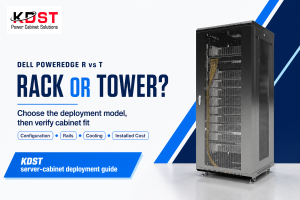
Designed for data centers and telecom applications in which the subrack is commonly used as the master enclosure, enclosures like the KDST IP40 server rack cabinet are specifically intended to be indoor cabinets that are pre-installed with cable management, best appliances and, in the case of the IP40, heat venting. KDST equipment plans adhere to ANSI/EIA-310 19-inch rack criteria, allowing for integration with all industry standard rackmount equipment.
No matter what the application, whether it is a simple junction box to hold splices or a full-height floor-mounted cabinet for a motor control center, the enclosure has to be right for the surroundings, equipment, and safety codes.
NEMA Ratings for Indoor Electrical Enclosures
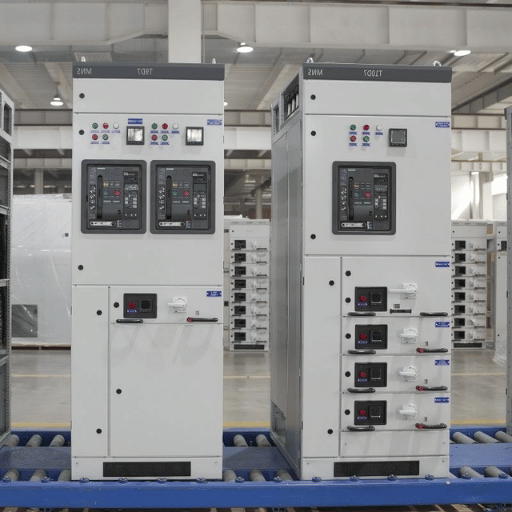
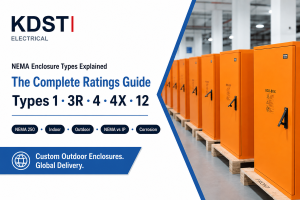
NEMA ratings are the main specification used in North America for indoor and outdoor electrical enclosures. Every rating describes the types of environmental hazards an enclosure provides protection from. For indoor use, the 3 most frequently specified ratings are NEMA Type 1, NEMA Type 12, and NEMA Type 4X.
Each provides a different level of protection.
| Feature | NEMA Type 1 | NEMA Type 12 | NEMA Type 4X |
|---|---|---|---|
| Location | Indoor only | Indoor only | Indoor / Outdoor |
| IP Equivalent | IP20 | IP52 | IP66 |
| Dust Protection | Falling dirt only | Circulating dust, lint, fibers | Dust-tight |
| Water Protection | Indirect splashing | Dripping, light splashing | Hose-directed water |
| Gasket | None | Full perimeter gasket | Full perimeter gasket |
| Corrosion Resistance | No | No | Yes |
| Typical Material | Painted CRS | Painted CRS or powder-coated | 304/316 SS or fiberglass |
| Use Case | Office IT panels, general wiring | Factory floors, machine shops | Food processing, chemical plants |
A NEMA 1 enclosure has minimal protection levels; it is only suitable for use inside dry, clean environments such as electrical rooms. It is rated to prevent contact with live components by unintended personnel and to prevent the ingress of falling debris, but offers no protection against airborne dust or moisture infiltration. NEMA 1 has an IP rating of 20—no protection from any water and protection from objects greater than 12.5 mm.
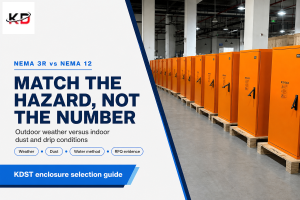
NEMA Type 12 is the most commonly used device rating for industrial indoor environments. It provides full perimeter gasketing and a sealed electrical cabinet construction to prevent circulating dust, lint, particles, and dripping or light splashing of noncorrosive liquids. Most steel electrical enclosure cabinets mounted in factory environments are NEMA 12 rated.
For indoor washdown or chemical-ridden environments, NEMA Type 4X protection is the standard provision. NEMA 4X rated enclosures can be specified for indoor or outdoor applications.
A key reminder: NEMA ratings are not interchangeable with IP ratings. As explained in the NEMA vs. IP ratings comparison guide, NEMA ratings extend well beyond the common dust and water protections offered by IP codes. Gasket age, corrosion resistance, oil immersion protection, and de-icing qualities all are tested under the NEMA system and not included in the IP system. An enclosure tested for IP66 is not automatically NEMA 4X compliant. For an IP40-rated indoor cabinet, the closest match would be straight up between NEMA 1 and NEMA 12, depending on construction specifics
Necessary clarification: specifying NEMA 1 for a washdown-intensive facility can be a costly specification error. NEMA 4X is the prescribed minimum for directed water spray or chemical environments. Going below this rating could void warranties and cause OSHA electrical safety hazards.
Enclosure Materials — Carbon Steel vs. Stainless Steel vs. Fiberglass
Electrical enclosure cabinet material selection affects the product’s strength, weight, influence by hot or cold operating environments, susceptibility to corrosion, ease of machining, and cost. Four standard options — cold-rolled carbon steel, 304 stainless steel, 316L stainless steel and fiberglass(GRP, FRP, GRP), are distinguished below.
| Property | Cold-Rolled Carbon Steel | 304 Stainless Steel | 316L Stainless Steel | Fiberglass (FRP) |
|---|---|---|---|---|
| Tensile Strength | ~400 MPa | ~515 MPa | ~485 MPa | ~200 MPa |
| Density | 7.85 g/cm³ | 8.0 g/cm³ | 8.0 g/cm³ | 1.8–2.0 g/cm³ |
| Corrosion Resistance | Low (requires coating) | Good (Cr/Ni passivation) | Excellent (Mo addition) | Excellent (non-metallic) |
| Thermal Conductivity | ~50 W/m·K | ~16 W/m·K | ~16 W/m·K | ~0.3 W/m·K |
| Field Modification | Easy (drill, punch) | Difficult (work-hardening) | Difficult | Moderate (may splinter) |
| Relative Cost Index | 1× | 2–3× | 3–4× | 1.5–2× |
✔ Steel Enclosures — Advantages
- Best overall strength and impact resistance of common enclosure options
- Most budget-friendly and easily customized to fit irregular applications
- Superior passive heat dissipation due to high thermal conductivity (50 W/m K for CRS)
- Washdown and corrosive conditioncertified
- Innately offers EMI/RFI shielding for control panels housed within
✔ Fiberglass (FRP) Enclosures — Advantages
- Lightest of the most common enclosure options at 75-78% lighter (density of 1.8-2.0 g/cm vs 7.85-8.0 g/cm)
- Corrosion immune due to a natural oxide barrier (no coating needed, no effects of rust)
- Non-conductive, eliminating ground fault risks through the enclosure body
- Excellent (0.3 W/m K) or poor (0.43-0.49 W/m K) heat transfer qualities effectively act as a thermal insulator depending on local environment
📐 Engineering Note
Chloride exposure from CIP(washdown) cycles causes food industry standard 316L stainless steel to be the spec of choice in pharmaceutical and food processing industry facilities. The low pitting-tending molybdenum element in 316L stainless steel maintains superior resistance to chloride concentrations above the 200 ppm threshold, which is experienced in dairy and meat-processing installations. In confined food processing facilities following 3-A Sanitary Standards guidelines, 316L stainless is the default selection.
A practical selection scheme moves according to three individual parameters: project-specific chloride exposure pattern (between carbon steel, stainless steel and GRP reinforces in aggressive environments, or painting for the least expensive option), load force requirement (eliminates fiberglass for high impact-force locations), and project expense budget(Cost point of 1 for carbon steel with paint, to 3-4 for 316L stainless steel). Emphasizing each in turn avoids gold-plating, as carbon steel painted cabinets in similar applications will result in equal performance.
Standard Sizes, Configurations, and Accessories

There are many standard size indoor electrical enclosure cabinets available. The enclosure size needed should consider not just the size of current instrumentation components, but also planned wiring, thermal, and infrastructure needs.
| Category | Typical Size Range (H×W×D) | Application |
|---|---|---|
| Small wall-mount box | 8×6×4 in to 16×14×8 in | Junction box, small relay panel |
| Medium wall-mount enclosure | 20×20×8 in to 36×30×12 in | PLC panels, VFD enclosures |
| Free-standing cabinet | 60×36×18 in to 84×36×24 in | Motor control centers, server racks |
| Floor-mount pedestal | 24×24×10 in to 48×36×18 in | Substation control, operator interfaces |
For rack-mount enclosures, KDST server rack cabinets conform to ANSI/EIA-310 standards of 19-in width for rack mount widths for direct compatibility with switches, patch panels, and servers with power supplies from all major equipment series
Common Accessories
While the enclosure itself may seem small, the internal design and accessories can be complex. some standard options include:
- Sub-panels and back plates provide flat mounting surfaces, made of 14 ga or 12 ga painted steel most often.
- DIN rails (35 mm top-hat) provide a snap-mount system for circuit breakers, terminal strips and relays
- Wire ducts, cable glands, cord grips and strain reliefs organize field wiring runs
- Filtered fans, vented cooling plates, thermoelectric coolers or enclosed AC Units remove heat from power dense components.
- Door locking hardware includes continuous or hinge reinforcement, removable-pined doors, quarter-turn or lock-bar latches and fasteners.
- Safety accessories include: door switch blanks, padlock hasps, grounding kits, window kits
📐 Engineering Note
The NEC limits conductor fill to a maximum of 40% cross-sectional area for feed through wiring and 75% for splices and taps (NEC Article 312.8). Allowing about 25-30% free inside the enclosure leaves room for future expansion and improves airflow especially inside control panels with high heat loads from motors fed by VFDs and power supplies.
Mounting Options — Wall-Mount, Free-Standing, and Floor-Mount

Determining the method for mounting an indoor electrical enclosure cabinet is influenced by the estimated load (kg or lb), space available, access considerations, and structural constraints of the building. The most popular methods are listed here.
| Criteria | Wall-Mount | Free-Standing | Floor-Mount (Pedestal) |
|---|---|---|---|
| Typical Load Capacity | 25–50 kg (55–110 lb) | 100–500 kg (220–1,100 lb) | 50–200 kg (110–440 lb) |
| Typical Size Range | Up to 36×30×12 in | 60×36×18 in to 84×36×24 in | 24×24×10 in to 48×36×18 in |
| Best For | Branch circuit panels, small PLCs | Motor control centers, server racks | Substations, operator kiosks |
| Installation Complexity | Moderate (stud spacing critical) | Low (anchor to floor) | Moderate (concrete pad) |
Wall-mount enclosures are common for smaller control panels and branch circuit wiring. They are conveniently positioned at an accessible height but rely on the wall structure for support. Wood-stud walls have lower loading potentials than steel-stud or block walls.
Free-standing enclosures are placed on their own base frame and anchored to the floor with concrete or lag bolts. They are popular for large automation projects, server room enclosures and motor control centers. They typically allow for leveling and caster mounts.
Floor-mount (or pedestal) enclosures are placed on a steel frame base-plate welded to the enclosure. Pedestals are used in substations and wet locations and are typically elevated 4-12 in off the floor.
Pro Tip: For wall mount enclosures over 30 lb (14 kg) check the wall structure – standard 16 in centers wood-studs have far less supporting capacity than concrete block or steel-studs. When your cabinet exceeds 50 lbs (23 kg), a pedestal with two-foot wall brace is preferred over the wall mount method.
How to Select the Right Indoor Enclosure for Your Application

Designating the correct indoor electrical enclosure cabinet requires a systematic method. While it can be tempting to take shortcuts, missing steps likely results in either underdesigning (a safety risk) or overdesigning (adding excessive project cost). This six step process guides you through all decision points:
6-Step Selection Checklist
- Identify the installation condition. Is this indoor dry (office, data center), indoor dusty (warehouse, factory), or indoor washdown (pharmaceutical, food processing)? The proper determination sets the initial enclosure protection level.
- Set the NEMA/IP enclosure rating. Applying the above identified environment to the proper NEMA type Type 1 (clean/dry), Type 12 (dusty/industrial), Type 4X (washdown/corrosive). When in doubt, specify one higher enclosure rating.
- Select enclosure material based upon corrosion potential and temperature needs. Use carbon steel for everyday indoor panels, 304 stainless for medium corrosion, 316L stainless for chloride/sea-air environments, fiberglass for high electrical insulation/non-conductive or high corrosion areas.
- Determine available interior volume. Adding up the measure of all components, then adding 25 30% to allow for wire bend radius, air flow, ventilation, and expansion.
- Identify mounting method. Wall-mount for equipment weighing less than 50 kg, free-standing for large cabinets, or floor-mount for mounted system use. Confirm the supporting structure is sufficient for load and vibration.
- Perform a final check. UL 508A standards apply to any industrial control panel (up to 1,000 V). Wiring enclosure fill calculations per NEC Article 312. Proper grounding per NEC Article 250. Complete all certification paperwork for the official final review by the AHJ.
Pro tip. When specifying enclosures for industrial control panels, verify that the enclosure supplier has a UL Listed or Recognized enclosure available to meet UL 508A. KDST can produce special order enclosure designs with proper construction documentation, from concept to delivery removing the enclosure manufacturer from your project timeline.
This simple master checklist makes certain you will have an enclosure that protects the equipment, satisfies code, fits on your wall, and meets budget. When specialty enclosure modifications and configurations are needed – specific custom dimensions, conveinance hinge placement, integration of power/thermal management, specialty finishes – directly working with your enclosure manufacturer and panel supplier will save costly project rework.
Frequently Asked Questions
Q: What is the difference between NEMA 1 and NEMA 12 enclosures?
View Answer
Q: Can I use an indoor electrical enclosure outdoors?
View Answer
Q: What gauge steel is used in electrical enclosure cabinets?
View Answer
Q: How do I determine the right enclosure size for my components?
View Answer
Q: What is the IP equivalent of a NEMA 1 enclosure?
View Answer
Q: Do indoor electrical enclosures need to be grounded?
View Answer
Yes. NEC Article 250.110 mandates that each metal enclosure housing conductors or equipment shall be grounded, including steel enclosures of all types NEMA types 1-13. The enclosure shall also be bonded to the equipment grounding conductor by means of a listed grounding lug, grounding bus bar, or approved grounding kit.
The Enclosure is non-conductive, however, any metal sub-panel, DIN rail, or mounting plates located within the enclosure shall still be individually grounded according to code.
Need a Custom Indoor Electrical Enclosure?
KDST KCfoundedk scustom designed protective enclosures on time and at a competitive price, from concept to delivery.
About This Analysis
Indoor electrical enclosure cabinet selection guide: This guide is based on information obtained from published NEMA, NEC and UL requirements as well as general engineering guidelines and personal experience from industrial and commercial electrical installation. KDST is used here as an example of enclosure manufacturer where design-to-finish/ship manufacturing process is used for custom enclosure solutions from engineering sketches to finished enclosure, then to painted, and shipped solution. Data presented here is typical enclosure manufacturer requirements and considered typical and should be verified with existing project requirements.
References & Sources
- NEMA 250-2020 — Enclosures for Electrical Equipment (1,000 Volts Maximum) — National Electrical Manufacturers Association
- NEC Article 312 — Cabinets, Cutout Boxes, and Meter Socket Enclosures — National Fire Protection Association
- UL 508A — Standard for Industrial Control Panels — Underwriters Laboratories
- NEMA vs IP Ratings Brief Comparison — National Electrical Manufacturers Association
- Electrical Safety Standards — Occupational Safety and Health Administration
Related Articles
- IP40 Server Rack Cabinet — Indoor data and telecom rack-mount enclosure
- Custom Outdoor Enclosure OEM Solutions — Weather-rated cabinets for outdoor use
- About KDST — Design-to-delivery enclosure manufacturing