
IP40 vs IP20 Ingress Protection Ratings: A Side-by-Side Comparison for Electrical Enclosures
How does selecting the wrong IP rating leave electronics vulnerable to debris, introduce manufacturing delays and void warranties? The simple answer is because even a seasoned engineer struggles to differentiate between the two IP classifications. As both ratings feature a “0” against liquids, neither enclosure provides an impenetrable barrier to dust. Considering how easy it is to tell the ratings apart, what are the fundamental differences? This abbreviated guide e×plains exactly this in detail.
Quick Specs
| Standard | IEC 60529 (International Electrotechnical Commission) |
| IP20 — First Digit | 2 — Protected against solid objects >12.5 mm |
| IP40 — First Digit | 4 — Protected against solid objects >1.0 mm |
| Second Digit (Both) | 0 — No liquid protection tested |
| Key Difference | IP40 blocks particles down to 1.0 mm; IP20 only blocks objects >12.5 mm |
| Common Applications | Server racks, telecom cabinets, distribution boards, switchgear |
What Do IP Ratings Mean? The Two-Digit System Explained
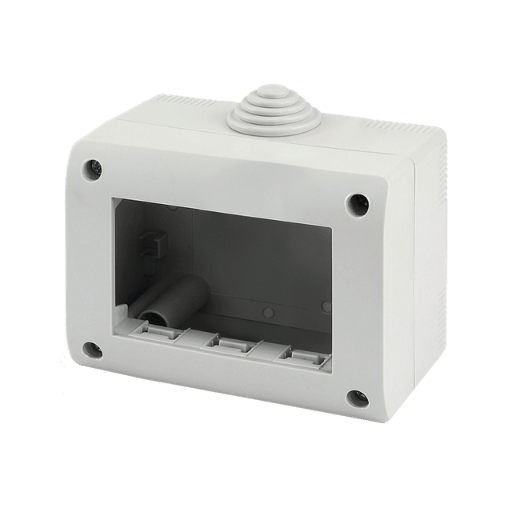
IP defined abbreviated.
IP denotes Ingress Protection, a ratings framework published under the IEC 60529 standard. First drawn up in 1976 and most recently revised in 2013, the two digit code assigns measured quantities to any given enclosure. This detailed code eliminates confusion when choosing an enclosure.
The modern IP code.
Evolving from its classical predecessor, the first digit (scaling between 0 to 6) in the modern IP framework defines ingress protection from solid objects. Equally, the second digit (0 – 9K) defines ingress protection from liquids. A rating of 0 against solids means unprotected; 6 means fully protected against dust. A rating of 0 against liquids means no entry for water; 9K means highly resistant against high pressure washers and the like.
Decoding the two digit code.
Measuring the degrees of ingress protection with the individual digits alone has been found to be an effective classification method. As you read, take each digit in isolation. For example, an IP40 enclosure guarantees no entry to objects above 1.0mm diameter (digit 1), and no ingress of liquids whatsoever (digit 2). Meanwhile, the IP20 enclosure does the same for 12.5 mm objects.
How to read the two digit code.
Important to bear in mind that, whatever the rating, the two digits are not cumulative. An IP40 enclosure does not defend against penetration of dust or dirt in roughly equal measure to an IP50 enclosure, but in fact “4 + 0 = 4.” Precisely, even the distinction between each of the 16 alternatives is sharply delineated and especially means a different design choice than originally envisaged.
IP40 vs IP20 at a Glance — Quick Comparison Table

All the possible categories.
Unboxing the engineering specifications of the two ratings reveals precisely how the two IP standards successfully differ by this magnitude, in layman’s terms. Every value below is directly referenced from the IEC 60529 test procedure documents.
| Feature | IP20 | IP40 |
|---|---|---|
| Minimum blocked solid size | >12.5 mm | >1.0 mm |
| Test probe | 12 mm jointed finger, 10 N force | 1.0 mm rigid wire, 1 N force |
| Liquid protection | None (digit 0) | None (digit 0) |
| Dust ingress | Permitted — particles <12.5 mm can enter | Permitted — particles <1.0 mm can enter |
| Finger/tool contact protection | Fingers blocked; small tools can pass | Fingers, most tools, and wires blocked |
| Typical environment | Clean indoor, climate-controlled | Indoor with moderate particulate risk |
Every value quoted is directly referenced from IEC 255.
In engineering terms, IP40 allows protection against particles roughly 12x smaller than the particles the IP20 rating does. The cases which were mentioned at the start which allow debris to build up on electronics, creating kill or safety hazards, are far more likely to be protected by the stricter rating.
Solid Particle Protection — First Digit Breakdown
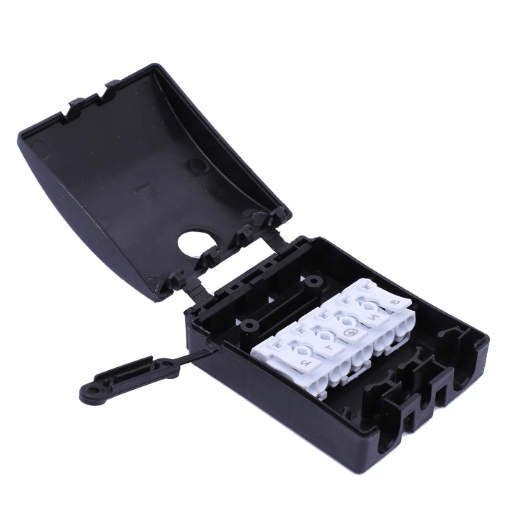
Sizing up the differences.
The First digit in the IP marking verifies what a given enclosure guards against and as part of the IEC 63055 test procedure tests for. This detailed onrogator demonstrates the exact force values involved.
| First Digit | Protection Level | Test Probe / Condition |
|---|---|---|
| 0 | No protection | No test required |
| 1 | Objects >50 mm | 50 mm sphere, 50 N force |
| 2 (IP20) | Objects >12.5 mm | Jointed test finger: 12 mm diameter, 80 mm length, 10 N force |
| 3 | Objects >2.5 mm | Rigid steel wire: 2.5 mm diameter, 3 N force |
| 4 (IP40) | Objects greater than 1 mm | Rigid steel wire: 1.0 mm diameter, 1 N force |
| 5 | Dust-protected (limited ingress) | Vacuum test: <2 kPa, 8-hour cycle |
| 6 | Dust-tight (zero ingress) | Vacuum test: <2 kPa, 8-hour cycle, zero particles |
📐 Engineering Note
The force applied in the first digit test.
Neither IP20 nor IP40 offers protection against dust ingress, but neither of those ratings offers protection from dust. An IP20 enclosure is not dust proof; it prevents contact with objects over 12.5mm in diameter, which is just over the width of a finger, but remains open to dust particles like sawdust, metal filings, or conductive debris less than 12.5mm, which pass straight through. If your installation surrounds are prone to fine particulate, avoid IP20 enclosures.
Moisture and Liquid Protection — Second Digit Comparison
Both IP20 and IP40 share the same second digit, 0. None of IEC IP66 IP65 IP68 IP69K. No water ingress testing has been done at all.
To get an idea of just how low this 0 actually is, you need to look at the full scale for the second number as specified by IEC 60529:
| Second Digit | Protection Against | Test Condition |
|---|---|---|
| 0 (IP20 & IP40) | No protection | No test |
| 1 | Vertically falling drops | 1 mm/min rainfall, 10-minute duration |
| 2 | Drops tilted 15° | Enclosure tilted 15° from vertical |
| 3 | Spraying water | 60° arc from vertical, 10 L/min |
| 4 | Splashing water | All directions, 10 L/min |
| 5 | Water jets | 6.3 mm nozzle, 12.5 L/min, all directions |
| 6 | Powerful water jets | 12.5 mm nozzle, 100 L/min |
| 7 | Temporary immersion | 1 m depth, 30 minutes |
| 8 | Continuous immersion in water | Depth per manufacturer spec, extended duration |
| 9K | High-pressure steam cleaning | 80°C water, 80–100 bar, close range |
An IP40 enclosure is not waterproof, an IP rating with a 4 as the second number is necessary for this. The 4 in IP40 refers to the solid ingress protection, where as the 0 refers to the liquid ingress protection stating that the enclosure has not been tested in this category – if moisture, condensation or washdown are a concern you need an IP rating with a second number of 4 or higher – an IP rating such as 4,5 or 6, for low-pressure water situations. In addition, an IPx7 (immersion) test is not assumed to include the IPx5 (jets). Each test is independent unless dual rated.
Common IP Ratings Chart — Where IP40 and IP20 Fit

IP20 and IP40 are rated at the bottom of the spectrum on ingress protection with the most protection available being IP69K. To understand where they are on the spectrum its useful to see them next to some of the ratings most often specified by telecom enclosures, electrical cabinets and industrial housings.
| IP Rating | Solid Protection | Liquid Protection | Typical Application |
|---|---|---|---|
| IP20 | Objects >12.5 mm | None | Indoor distribution boards, lighting fixtures |
| IP40 | Objects >1.0 mm | None | Server racks, telecom cabinets, clean indoor enclosures |
| IP44 | Objects >1.0 mm | Splashing water (all directions) | Covered outdoor outlets, bathroom fixtures (zone 2) |
| IP54 | Dust-protected (limited ingress) | Splashing water | General outdoor use, factory floors |
| IP55 | Dust-protected | Water jets (6.3 mm nozzle) | Outdoor electrical enclosures, vehicle components |
| IP65 | Dust-tight (zero ingress) | Water jets | Washdown environments, food processing |
| IP66 | Dust-tight | Powerful water jets (12.5 mm nozzle) | Marine equipment, heavy industrial |
| IP67 | Dust-tight | Temporary immersion (1 m, 30 min) | Submersible connectors, outdoor sensors |
| IP68 | Dust-tight | Continuous immersion (manufacturer-specified depth) | Underwater housings, deep-well pumps |
NEMA ratings such as NEMA 1, 4 or 4X are sometimes employed in parallel with IP specifications, but there is no one-to-one correspondence between them. In general, the NEMA system includes tests for corrosion resistance, icing, oil immersion and gasket aging that the IEC 60529 specifications do not — a NEMA enclosure meeting a given IP rating may likely surpass it in protective capability, but an IP enclosure will not necessarily meet the requirements for a NEMA rating.
IP40-rated server rack cabinets are the typical choice for much of our data center and telecom company clients. They address the minimal particulate hazards of a temperature-controlled indoor environment near unsealed cabinets without the more costly ventilation issues of sealed IP5X or IP6X enclosures.
Which Should You Choose? IP40 vs IP20 Decision Framework

Your decision should depend on the specifics of your installation environment, any regulatory or industry standards you must adhere to, and your own level of acceptable risk. Use this list to guide you.
1. What particulates are in the environment? If the space is a sealed server room with filtered HVAC and no construction, IP20 may be adequate. If the environment regularly involves cable plugging, unplugging or termination, or if your space contains manufacturing machinery, fine particulates below 12.5 mm are sure to be present, and so an IP40 enclosure would be the better option.
2. How small is the maximum hazardous particle? Conductive debris as small as 1-2 mm long can bridge two adjacent PCB pads and short out the circuit. IP20 allows anything smaller than 12.5 mm to get in – IP40 keeps out debris down to 1.0mm, which would take care of the majority of conductive particulate risk indoors.
3. Which IEC or local standards, or which customer specifications, require a minimum IP rating?
Several telecom standards and data center specifications (TSIA, 942, for example) specify a minimum IP rating for cabinets. This should be verified with the project specs early on – an IP20 enclosure that is rejected by a customer audit will be costly to replace once installed.
4. What is the benefit-to-overall cost ratio?
Existing studies indicate that the cost differential between similar-sized IP20 and IP40 enclosures tends to be between 8-15%. When averaging this over the cost of an equipment failure due to ingress of debris, the added expense of an IP40 enclosure is received positively in the majority of cases.
| Scenario | Recommended Rating | Reason |
|---|---|---|
| Sealed, climate-controlled server room | IP20 (minimum) or IP40 (preferred) | Minimal particulate risk, but IP40 guards against maintenance debris |
| Telecom hub with active cable work | IP40 | Wire offcuts and insulation shavings <12.5 mm are routinely generated |
| Workshop or light manufacturing floor | IP44 or IP54 | Liquid splashes and heavy dust exceed both IP20 and IP40 limits |
| Outdoor or semi-exposed location | IP55 or IP65 | Rain, wind-driven debris, and dust storms require full dust and jet protection |
| Residential distribution panel (indoor) | IP40 | Blocks household debris and provides finger-safe protection per most local codes |
✔ Advantages of IP40 over IP20
- Blocks particles down to 1.0 mm – 12 finer filtration than IP20
- Stops waste wire, small metal chips, and insects from entering
- Meets stricter telecom and data center cabinet specifications
- Reduces short-circuit risk from conductive debris
⚠ Limitations to Consider
- No protection against liquids provided either IP20 or IP40 (digit 2 = 0).
- IP40 is neither a gas-tight sealing nor does it prevent fine dust (particles < 1.0 mm) from entering the enclosure.
- Tighter sealing may reduce natural airflow; verify thermal specs
- If you go for the IP40 model, then expect to pay 8-15% more than the similar IP20 enclosure.
KDST produces standard and custom-depth electrical enclosures, as well as the packaging in KDST’s IP40 server rack cabinet family, as is certified to IEC 60529 conditions for first-digit-4 solid ingress protection.
About This Comparison
KDST , an electrical and telecom enclosure manufacturer, makes IP40 rated server rack enclosures. This article uses the IP rating scheme directly for enclosure and cabinet selection – an angle not seen in search results, which are more often making applications for IP lighting and consumer electronics. All IEC 60529 test specifications referenced are extracted from the published standard.
Product environment recommendations are standard industry practice and should be checked against the actual project conditions.
Frequently Asked Questions
Q: Is IP40 better than IP20?
View Answer
The solid particle protection of IP40 enclosure is much better than IP20. IP40 enclosure prevents the objects larger than 1.0mm to entry, while IP20 only prevents the objects larger than 12.5mm. If there are lots of small debris, wire clippings or bug inside, and these components are vulnerable in the enclosure, then IP40 should be specified.
But again, it depends – for a enclosed environment which contains no particles, then perhaps as low as IP20 would suffice and also saving cost. Again, no liquid ingress protection.
Q: Is IP20 ok for outside?
View Answer
Yes. IP 20 offers no liquid protection and will only impede solid objects over 12.5 mm in size. Any outdoor application will however be subjected to rain, wind-blown particles, insect matter and moisture.
For general outdoor applications an IP54, IP55 level is normally seen as the minimum level.
Q: Is IP40 water resistant?
View Answer
No. The ‘0’ in the second position refers to no water ingress test was carried out. IP40 just specifies protection against solid particle ingress.
For protection against water, the second number must be 4 or greater — for example IP44 (splash-proof) or IP65 (jet-proof). It is common to confuse the first number representing protection against solid particles with overall protection level in the final enclosure specification.
Q: Is IP20 enough for a bathroom?
View Answer
It does based on the bathroom zone. In zone 0 (inside the bath or shower tray) a minimum of IPx7 is normally taken. In zone 1 (above the bath) the minimum is normally taken as IPx4.
In zone 2 (with in 0.6 m of the bath) the minimum is normally taken as IPx4. IP20 is only acceptable in areas which are outside the zones of the bathroom – normally 3m or more away from any water supply. Also check the local electrical code.
Q: What does IEC 60529 cover?
View Answer
Q: Can I upgrade an IP20 enclosure to IP40?
View Answer
In some situations, Yes – but it is not always a simple task. Most examples are either to fit mesh filters and sealed cable entry points or replacing ventilation grilles for finer rated versions. Difficulties arise as any changes must then be re- tested to IEC 60529 to achieve a genuine IP40 rating.
Any self- modified IP40 rated enclosure that is not re-tested is risking potential liability if trying to claim IP40. It is often more viable and cost effective to select and specify an IP40 enclosure, to be bought from the outset.
Q: What IP rating do I need for a server rack?
View Answer
For indoor data centers and telecom rooms the common rating specified is IP40. It generally stops wire trimmings and other “edge” debris produced by patching and servicing but permits sufficient flow of air to cool the equipment. IP20 racks are available but leave the equipment open to the flow of solids sized 1.0mm – 12.5mm, which includes many conductive particles.
For dusty plant or loading dock applications, IP54 may be required. Consider IP40 server rack cabinets from KDST, engineered for data center and telecom applications, IEC 60529 tested.
References & Sources
- IP Ratings — International Electrotechnical Commission (IEC)
- IP Code — Wikipedia
- Ingress Protection Ratings — NEMA Enclosures
- What Is IP Testing? — F2 Labs (IEC 60529 Testing Overview)
- NEMA Ratings and IP Equivalents — Fibox USA


![What Is a Power Box? Types, Functions & Selection Guide [2026]](https://www.kdstelectrical.com/wp-content/uploads/0-9-300x200.png)
