What to Know Before Choosing an OEM Enclosure Manufacturer
📐 Quick Specs
- Article Type: Authority Guide — OEM Enclosure Manufacturing
- Key Standards: nema 250-2020, UL 50/50E, IEC 60529, ASTM B117
- Materials Covered: CRS, 304SS, 316SS, Aluminum, Polycarbonate
- NEMA Ratings: Type 1, 3R, 4, 4X, 12
- Typical Lead Time: 4–12 weeks (custom), 1–3 weeks (standard)
Choosing an OEM enclosure manufacturer impacts every factor downstream – BOM cost/lead time, field reliability, reg compliance. Yet procurement engineers only consider a vendor as a dollar amount, ignoring questions related to tooling capability, NEMA rating requirements, material traceability. This guide walks through the sourcing decision – what OEM enclosure fabrication entails, exactly how to specify materials/ NEMA ratings, how to spot an experienced manufacturer and save by asking the right questions. Just need a few cheap, durable, build-to-order enclosures for an OEM project? Whether its only 3 custom electrical enclosure, or 10,000 steel enclosures, this evaluation helps.
What Does an OEM Enclosure Manufacturer Actually Do?
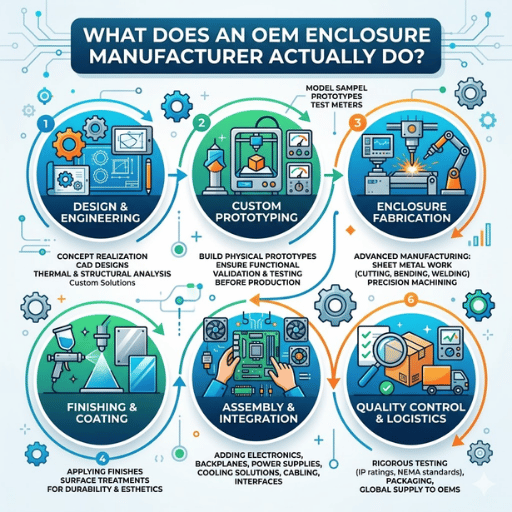
An OEM enclosure manufacturer produces enclosures per another company’s specs. The customer owns the design (or co-designs), and the manufacturer handles fabrication, welding, assembly, and QC to meet or exceed the customer’s exact specifications. Here are key differences from ODM and off-the-shelf:
| Factor | OEM | ODM | Off-the-Shelf |
|---|---|---|---|
| Design Ownership | Buyer owns IP | Manufacturer owns base design | Catalog standard, no IP |
| Tooling Investment | $2,000–$15,000+ (buyer-funded) | $0–$3,000 (shared molds) | $0 |
| MOQ Range | 50–500 units typical | 100–1,000 units typical | 1 unit |
| Customization Depth | Full: dimensions, cutouts, finish, gasket | Partial: color, labeling, minor mods | None or drill-to-order only |
| Lead Time | 6–12 weeks (first run) | 4–8 weeks | 1–5 business days |
The standard OEM enclosure production process follows six stages:
Design Review Prototyping Tooling Production QC Shipping
During design review, design/layout teams validate 0.5 sheet metal bend tolerance, gasket seal ID/OD, component locations. Prototyping typically includes 1-3 production-style units for fit checks. Tooling covers forming dies, jigs, and fixtures specific to OEM design. Production relies on CNC, welding, and dimensional QC to drawing specs.
📐 Engineering Note: Sheet metal forming tolerances are ±0.5° (per ASME Y14.5). Enclosures with IP-rated gasket sealing require controlled seal crush; specify ±0.25mm on critical flanges.
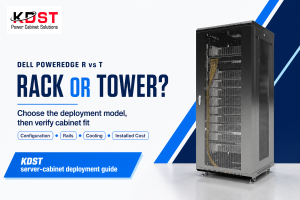
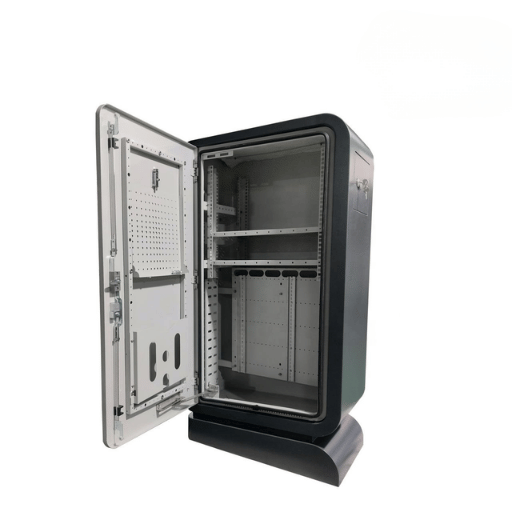
KDST manufactures build enclosures for telecom, data center, and solar fields including these server rack enclosures built for U.S. telco clients with IP40 protection.
Materials and NEMA Ratings — How to Spec an Enclosure
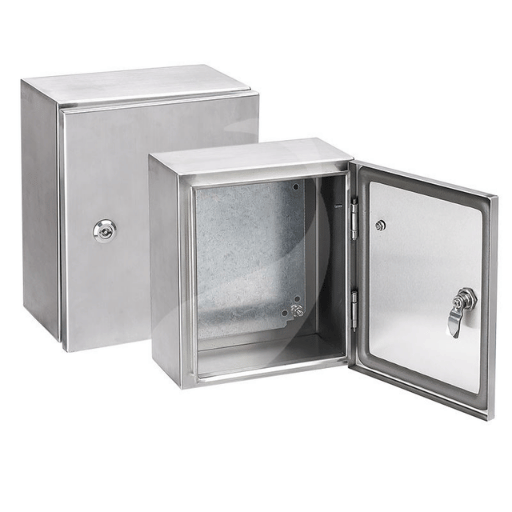
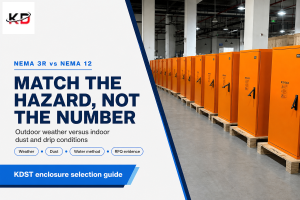
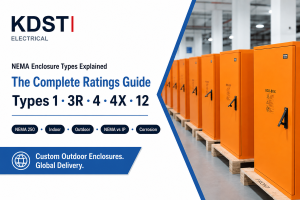
Material and nema type are by far the most complex specification decisions. Mishandled here and you’ll suffer field failures, warranty claims, or compliance violations. How do the NEMA types relate to real-world needs:
| NEMA Type | IP Equivalent | Typical Material | Environment | Test Standard |
|---|---|---|---|---|
| NEMA 1 | IP20 | CRS (16–14 ga.) | Indoor, dry | NEMA 250-2020 §4.1 |
| NEMA 3R | IP14 | Galvanized steel / Aluminum | Outdoor, rain, sleet, ice | NEMA 250-2020 §4.3 |
| NEMA 4 | IP66 | 304 Stainless / Painted CRS | Outdoor, hosedown, windblown dust | NEMA 250-2020 §4.4 |
| NEMA 4X | IP66 | 316 Stainless / Fiberglass | Outdoor, corrosive, hosedown | NEMA 250-2020 §4.4 + ASTM B117 |
| NEMA 12 | IP55 | CRS (14–12 ga.) | Indoor, dust, dripping water, oil | NEMA 250-2020 §4.5 |
Note that nema classifications do not directly match IEC/IP – a NEMA 4 isn’t automatically IP66, for example, as corrosion resistance and external icing test conditions differ.
Material is equally as influential on nema compliance, enclosure longevity, and CFO. The chart compares the five most popular enclosure materials:
| Material | Wall Thickness | Weight Class | Corrosion Resistance | Best For |
|---|---|---|---|---|
| Cold-Rolled Steel (CRS) | 1.2–2.0 mm (16–14 ga.) | 7.85 g/cm³ | Requires powder coating or plating | Indoor NEMA 1/12, cost-driven projects |
| 304 Stainless Steel | 1.5–2.0 mm (16–14 ga.) | 8.00 g/cm³ | Good — resists most atmospheric corrosion | NEMA 4, food processing, washdown |
| 316 Stainless Steel | 1.5–2.5 mm (16–12 ga.) | 8.00 g/cm³ | Excellent — resists chlorides and marine salt | NEMA 4X, coastal, chemical plants |
| Aluminum (5052/6061) | 2.0–3.0 mm (14–10 ga.) | 2.68 g/cm³ | Good with anodizing; avoid salt contact | Lightweight outdoor, telecom, transport |
| Polycarbonate | 3.0–5.0 mm | 1.20 g/cm³ | Inherent — non-metallic, UV-stabilized grades | Small junction boxes, UV-exposed outdoor |
Carbon steel is by far the most popular enclosure material, for its ductility and cost per unit weight. For applications demanding corrosion resistance – applicable in almost any enclosure used in both indoor and outdoor ambient conditions – stainless steel or aluminum switch out carbon steel despite the 2-4x material cost jump.
For nema 4X applications specifically, 316 stainless steel is the 400-grade molybdenum steel alloy to specify. Its 2-3% content of molybdenum, holds off chloride-induced pitting and corrosion. OEM personnel working in coastal, chemical environs should request mill test reports (MTRs) for alloy composition.
Engineering Note: The nema 4X 316SS enclosures must be salt spray tested to ASTM B117 – a controlled chamber environment in 5% NaCl at 35 C. Minimum exposure time requirements are specified by each manufacturer spec, but 200 hours is a common standard for assessing corrosion resistance.
All enclosure type testing specs are defined by ANSI/NEMA and IEC standards. IEC 60529 defines the ingress protection (IP) code used internationally.
The Custom Enclosure Fabrication Process
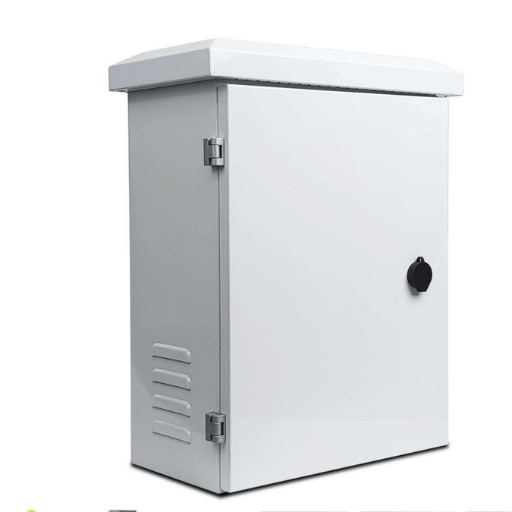
custom enclosure fabrication testing sequence is well documented and each step has defined tolerances. Cutting DFM review at the design stage prevents costly rework at the end of the process.
- Laser Cutting – Flat sheet steel blanks are precision laser cut using a fiber source to 0.005″ tolerance which is the foundation for all downstream dimensioning.
- CNC Punching – Mounting channels, louvers, knockout patterns, entry holes, and other holes are formed by CNC turret presses up to 200 hits / minute.
- Bending – Press brakes form sheet metal parts to 0.5 hole tolerance where possible. Angular error accumulated through bending multiple bends.
- Welding – Stainless steel enclosure TIG welding is standard, aluminum enclosure assembly is done by MIG welding on clean panels. All welded joints on sealed enclosures must be welded completely, no tack welding.
- Surface Treatment – Metal enclosures are powder coated 60-80 m (2.4-3.2 mils) thickness that forms part of the finished part set 0.010″ dimension. Aluminum stainless steel enclosures may be electropolished or passivated instead.
- Assembly – Gaskets, hinges, latches, DIN rails, sub panels, grounding studs, and mounting configuration hardware are installed at this stage. Final dimension inspection and gasket compression testing is also per formed during assembly.
Pro Tip: 💡 Address thermal management before fabrication. Ventilation cutouts, fan mounts or heat exchanger flanges added after final assembly of a enclosure compromises its structural integrity and can invalidate nema ratings. In custom enclosure projects, thermal concerns are incorporated into the design before production begins.
A professional enclosure manufacturer should actively participate in the DFM review to identify thermal issues before tooling begins. KDST projects have integrated thermal simulation data into the engineering package for IP40 server rack cabinet design.
How to Evaluate an OEM Enclosure Manufacturer
The level of the enclosure manufacturer can vary. Some work for full service OEM shops with engineering resources on hand, while others are simply thread drafters that follow the print. Use this 7 point initial screening list for engaging enclosure manufacturers:
Vendor Evaluation Checklist
- ISO 9001 certification – validates a documented quality management system
- In-house Engineering (CAD/CAM) – Will they make manufacturable design modifications?
- UL listing ability – Do they have UL 50/50E approval for enclosure testing?
- Material traceability – Will they provide your CoC and mill test reports on request?
- Fast prototyping – FAI turnaround within 2 weeks?
- Can they finish your enclosure in your shop – Powder coat, plating, or silk-screening?
- Flexibility of volume – Will they produce non-standard enclosure quantities from 50 to 5,000 units?
Points of Note: NEMA 250 is a self-declared rating — a manufacturer can sign off on a self-tested enclosure as “NEMA 4X”. UL 50/50E requires third-party testing and a factory audit. A NEMA type rating with no UL listing means the manufacturer certified their own product. Do you need code approval or local AHJ requirements? Demand a UL-listed enclosure.
Another myth: just because a enclosure is UL listed for Class I Division 1 (hazardous location) does not mean it is IEC Zone 1 capable. UL and IEC methods and acceptability criteria are different. If your electronic enclosure requires IEC and NEC zones, verify dual usage separately.
Source: UL Solutions – electrical enclosure Certification
Cost Factors in OEM Enclosure Manufacturing
📐 Key Cost Breakdown (Industry Average)
- Material: ~38% of unit cost
- Labor (fabrication + assembly): ~39%
- Energy (laser, press brake, ovens): ~7%
- Tooling: Amortized over production volume — varies widely
Pricing for an actual enclosure varies based on grade of material, nema rating, size, and quantity ordered. Typical ranges are:
| Enclosure Type | Material | Approx. Unit Cost |
|---|---|---|
| NEMA 1, small (12″×10″×6″) | Mild steel (CRS) | $80–$200 |
| NEMA 4, medium (24″×20″×8″) | 304 Stainless Steel | $250–$600 |
| NEMA 4X, custom (36″×30″×12″) | 316 Stainless Steel | $400–$1,200+ |
| NEMA 12, floor-standing (72″×36″×18″) | Carbon Steel, powder coated | $300–$900 |
Values above are aggregate estimates. Actual quotes will vary by order characteristics. Ask your sourcing agent for past quotes along similar order sizes for accurate budget planning.
Four ways to reduce enclosure costs:
- Stick to standard sizes. Use standard dimensions for speed, consistency, and material and tooling availability. Custom sizes cost more and take longer.
- Limit weld joints. Each weld adds labor hours — formed flange attachment hardware or screw-fastened panels reduce welding costs.
- Price in volume tiers. “As you go from 50 to 200 units, price per unit drops 15-25%.-If you can lock in 200 units a month over the next 6, 12, or 24 months you could be looking at direct material savings of tens of thousands of dollars.”1
- Send your design for a 2-hour DFM consultation, and a $5,000+ audit for downstream rework can be avoided.
Typical CNC machining rates in the United States range from around $80/hr for 3-axis to $150/hr for 4-axis, and up to $200/hr for 5-axis work. enclosure fabrication uses mostly 3-axis CNC mills, with 5-axis required for more complex copper or aluminum finned heatsink or waveguide flange components.
OEM Enclosure Applications Across Industries
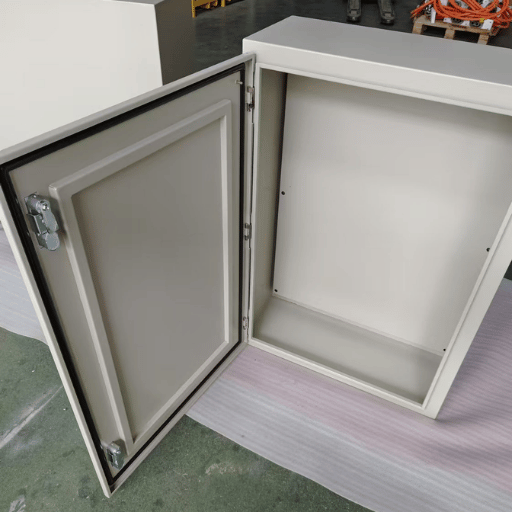
Different sectors will have different enclosure requirements. The enclosure solution for industrial enclosures in temperature-managed data center conditions is a poor choice for remote solar farm monitoring and storage sites. Here is how enclosures support the various environments:
| Industry | Typical NEMA Rating | Key Requirements | Common Enclosure Type |
|---|---|---|---|
| Telecom / 5G | NEMA 3R | Outdoor, pole-mount, thermal management | Aluminum or galvanized steel cabinet |
| Solar / Energy Storage | NEMA 4X | UV-resistant, corrosion-proof, hosedown-rated | 316SS or fiberglass NEMA 4X box |
| Industrial Automation | NEMA 12 | DIN rail mounting, oil/dust resistance | CRS floor-standing or wall-mount |
| Transportation / Traffic | NEMA 3R | Roadside, tamper-resistant, rain/ice protection | Aluminum traffic signal cabinet |
| Data Center | IP40+ | 19″ rack-mount, cable management, airflow | Steel server rack cabinet |
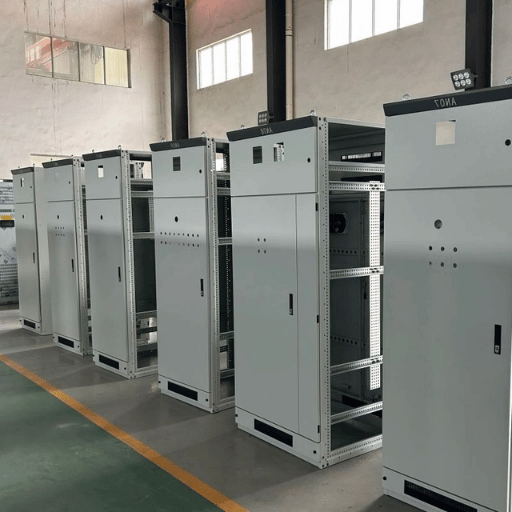
Data center and telecom applications rely on the KDST IP40 server rack enclosure family, 19″ EIA-310 compatible rails, built-in cabling, and customization options for outward depth and height and front, rear, or overhead door layout variability. Supports either internal colocation or edge computing, where cool, controlled airflow is desired.
If you require a enclosure outside the range of these enclosure solution – e.g., NEMA 4X corrosion resistance on a forced-air solar inverter module enclosure – a qualified OEM enclosure manufacturer will design and manufacture a fully custom electrical enclosure that addresses both criteria at the same time.
Frequently Asked Questions
What is the difference between OEM and ODM enclosures?
View Answer
OEM enclosures are designed and manufactured for the purchaser’s unique geometry, ownership of intellectual property, and control over all aspects of the design. ODM enclosures are built using the manufacturers existing design and the customer applies branding or tweaks less that 1%. OEMs are able to direct full customization; ODMs more rapidly deliver shelf-ready product.
How are custom enclosures manufactured?
View Answer
custom enclosure fabrication employs 6 steps: laser cutting sheet metal blanks (0.005″ tolerance), CNC punching for knock outs and mounting holes, press brake bending (0.5 tolerance), TIG or MIG welding joints, surface treatment (powder coat, passivation, etc.), mounting with hardware, gaskets and sub-panels. A DFM review at design time avoids costly rework at production time.
What NEMA rating do I need for outdoor enclosures?
View Answer
For outdoor use nema 3R will do… For hosedown environments or windblown dust, specify the higher NEMA 4. For corrosive outdoor environments (like chemical plants or coastal sites) specify NEMA 4X with 316 stainless steel – a corrosion resistant stainless that meets ASTM B117 testing.
How long does custom enclosure manufacturing take?
View Answer
Initial custom enclosures are 6-12 weeks for design review,Prototyping, tooling and initial production; repeat orders with fixed tooling are 3-5 weeks. Standard enclosures with small modifications are usually 1-3 weeks depending on manufacturer backlog.
What certifications should an enclosure manufacturer have?
View Answer
At least find ISO 9001, quality management systems certification. For electrical enclosures sold in North America look for UL 50 or UL 50E listing; it confirms UL independent third party testing. nema ratings are just self-declared. For international projects, IEC 60529 testing by a third party lab is required.
How much does a custom OEM enclosure cost?
View Answer
Small mild steel nema 1 enclosures are starting at about $80-$200 each. Custom NEMA 4X enclosures in 316 stainless steel can be from $400 to $1,200 depending on size and features; tooling costs are amortized into $2,000-$15,000.
Need a custom enclosure solution for your next project?
KDST designs and manufactures NEMA-rated electrical enclosures and metal cabinet housing for telecom, solar, data center, and industrial applications — from prototype through production.
Our Perspective on Enclosure Engineering
KDST Electrical designs and manufactures NEMA-rated electrical enclosures for telecom, solar, data center, and industrial outdoor applications — from prototype to mid-volume production. Specialization in NEMA 3R enclosures designed for outdoor mounting configurations and NEMA 4X corrosion-resistant custom solutions across multiple materials. Custom enclosure projects include full sheet metal fabrication, powder coat, and engineering to exact specifications for OEMs who need more than a catalog box.
References & Sources
- NEMA 250 Standard — National Electrical Manufacturers Association
- ASTM B117 Standard Practice for Salt Spray Testing
- UL 50E — Enclosures for Electrical Equipment, Environmental Considerations
- IEC 60529 IP Code — Wikipedia
- NEMA Enclosure Types — Wikipedia
- Schneider Electric — Equipment Enclosure White Paper