How to Choose the Right Outdoor Cabinet for Edge Computing Deployments
Quick Specs — Outdoor Edge Computing Cabinets
IP Ratings: IP55 – IP65
NEMA Ratings: 3R / 4 / 4X
Operating Temp: -40°C to +55°C
Cooling Capacity: 200W – 5,000W+
Power: 48V DC standard
Materials: Galvanized steel, aluminum, stainless steel
Why Edge Computing Is Moving Outdoors

Edge computing isn’t limited to air-conditioned server rooms within corporate buildings anymore. The world edge computing market raked in $61.14 billion in 2024 and is on pace to advance at a CAGR of 34.1% through 2030, reports Grand View Research. That explosive growth is shoving compute hardware away from centralized data centers and out into cell towers, street-side poles, warehouse perimeters and interstate corridors.
What’s driving the change? latency. Applications such as autonomous vehicle navigation, industrial process automation and real-time video analytics cannot afford the typical 30-80 ms round-trip delay to a regional data center. Processing data within 5-10 ms of where it’s generated requires deployed computing nodes at the network edge—and in most cases, that means outdoors.
Gartner predicted that by 2025, 75% of enterprise-generated data would be processed outside of traditional data centers. 5G rollouts are hastening that forecast. Asia alone will operate 1.8 million edge-enabled 5G base station sites by mid-2025, each outfitted with weatherized enclosures for radio units and co-located edge servers. Globally the number of IoT devices attached to edge infrastructure is expected to hit around 5,814 million by 2026.
$61.14B
Edge computing market size, 2024
75%
Enterprise data processed outside data centers
5,814M
Edge IoT devices worldwide by 2026
This infrastructure growth provokes a common engineering question: how to guard critical electronics—servers, switches, GPUs, radio units—against rain, dust, temperature extremes and vandalism when a building shell isn’t present. No-compromise outdoor cabinets are the answer. If you’re considering enclosures for an upcoming edge deployment, NEMA 3 IP55 outdoor cabinets constitute the standard level of protection most operators choose for new deployments.
What Makes an Outdoor Cabinet Suitable for Edge Deployments

Not all metallic enclosure types warrant an outdoor cabinet designation for edge computing. The difference is based on tested, certified ingress protection, which relies on two separate rating schemes: the international IP code (IEC 60529) and the North American NEMA 250 standard. Comprehending the testing specifics behind each rating helps ensure prevent expensive specification errors.
IP and NEMA Rating Comparison
| Rating | Dust Protection | Water Protection | Corrosion | Typical Use Case |
|---|---|---|---|---|
| IP55 | Limited ingress (not dust-tight) | Low-pressure jets (6.3 mm nozzle, 12.5 L/min) | No | General outdoor deployment |
| IP65 | Dust-tight (zero ingress) | High-pressure jets (6.3 mm, 12.5 L/min at 3 m) | No | Harsh outdoor / dusty industrial |
| NEMA 3R | Falling dirt | Rain, sleet, ice formation | No | Ventilated outdoor rack |
| NEMA 4 | Windblown dust | Splashing water, hose-directed | No | Fully sealed outdoor |
| NEMA 4X | Windblown dust | Splashing water, hose-directed | Salt fog per ASTM B117 | Coastal / marine environments |
Material selection is directly related to the environment. Marine-grade aluminum (5052-H32 alloy) can sustain salt air without excess weight — a real advantage for pole-mounted applications. Stainless steel 316L offers maximum corrosion resistance at coastal and offshore facilities, while 304-grade stainless is suitable for most inland industrial environments. Powder-coated finishes (minimum 80 micron thickness) block UV rays and limit heat gain.
Security should not be overlooked. outdoor edge cabinets at unmanned sites should incorporate multi-point door locks with tamper-evident seals. A three-point locking rod assembly secures the door at the top, middle and bottom simultaneously to ward off prying that single-point units can’t stop. Many enclosures also accept hasp attachments and e-lock logs for audit purposes.
Most common oversight: deploying indoor-only server racks at outdoor edge sites. Typical 19-inch indoor racks do not possess ingress ratings or gasket seals, are manufactured from untreated carbon steel, and have no condensation drains—the failure of which leads to equipment moisture damage in 3-6 months in temperate areas, and faster in tropical or marine environments.
For a typical outdoor edge deployment, an outdoor telecom cabinet rated IP55 / NEMA 3 will meet most requirements in temperate, non-coastal environments. NEMA 4X should be used where heavy dust or corrosion issues exist, using a fully sealed form factor.
Thermal Management for Outdoor Edge Cabinets
Heat is the primary enemy of outdoor edge computing equipment. ASHRAE TC 9.9 recommends keeping data processing gear within 18°C–27°C (64°F–81°F) for continuous operation. In practice, every 10°C increase over 27°C more than doubles the failure rate of a semiconductor junction.
The internal heat challenge at outdoor edge sites is two-sided. Internally, a single 5G radio unit produces 500-1,000 W of waste heat. An edge server with a mid-range GPU produces another 300-750 W. Externally, the solar irradiance on a dark-colored 1 m² cabinet surface can add 400–600 W to the internal thermal load on a clear summer day. Combined, these loads can raise internal temperatures beyond 70°C without active cooling – well past any equipment tolerance.
Cooling Method Comparison
| Cooling Method | Capacity | Sealed Cabinet? | Maintenance | Best For |
|---|---|---|---|---|
| Passive (convection) | ≤ 200 W | Yes | None | Low-power sensors, switches |
| Air-to-air heat exchanger | 200 – 2,500 W | Yes | Annual filter replacement | Mid-range edge servers |
| Compressor AC unit | 2,500 – 5,000 W+ | Yes | Biannual coil cleaning | High-density GPU / AI compute |
| Liquid cooling (direct-to-chip) | 5,000 W+ | Yes | Quarterly fluid check | AI inference clusters |
📐 Engineering Note — Heat Load Calculation
Q = Q_equip + Q_solar + Q_ambient
Solar gain: Q_solar = α × A × I
Where α = surface absorptivity (~0.4 for white paint, ~0.9 for dark paint), A = exposed surface area in m², I = peak solar irradiance (~1,000 W/m²). A white-painted cabinet with 1.2 m² of sun-facing surface absorbs roughly 480 W of solar heat – enough to drive a passively cooled enclosure to unsafe operating temperatures.
When selecting fans for ventilated (not sealed) enclosures, apply the rule of thumb: 10 CFM of airflow per watt of heat dissipation. With 500 W of heat load, roughly 50 CFM of forced ventilation is required. For sealed enclosures — the preferred option at dusty or humid sites — heat exchangers and compressor units must be rated to handle both equipment heat load and the solar heat gain calculated above.
High end computing loads at the edge – especially AI inferencing workloads running multiple GPUs – are now driven 3,000-8,000 W per cabinet. Liquid cooling is the only thermal management approach available at these densities, especially in outdoor locations where ambient air sucks exceed 40C.
Power Distribution and Connectivity in Outdoor Enclosures
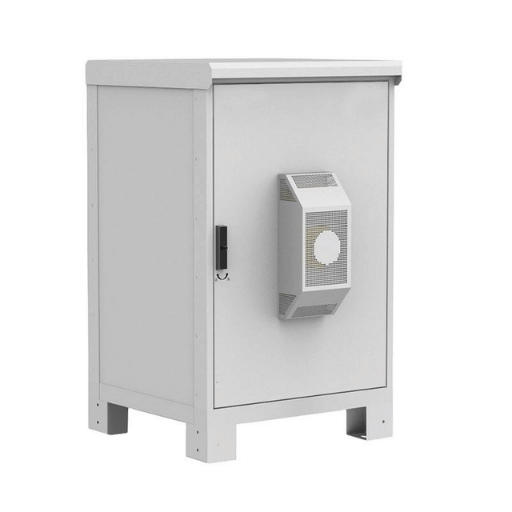
Most if not all telecom and edge computing deployments standardize on 48V DC power, per ETSI EN 300 132-2. 48 V bus is not an arbitrary selection: it falls below the 60 V DC limit that most electrical codes define as “safety extra-low voltage”, reducing insulation and protection needs. Virtually, 48 V DC carries twelve times the wattage of a 12 V system with same current, size wire gauge and similarly, most modern 48 V rectifiers reach efficiencies as high as 98%, reducing waste heat generated within the enclosure while distributing access efficiently across all rack-mounted equipment.
✔ Power System Checklist
Rectifier module – AC to 48 V DC conversion, N+1 redundancy recommended
Battery backup – Lithium iron phosphate (LFP) cells, 4-8 hour autonomy typical
Power distribution unit (PDU) – Branch circuit protection with per-outlet monitoring
Surge protection device (SPD) – Type 1+2 combined, rated for 20 kA per mode minimum
✔ Grounding bus bar — Single-point ground per ANSI/TIA-607-C
Pro Tip: designate N+1 rectifier configuration on any edge site where a truck roll costs more than the redundant module. If you have three 3kW rectifiers, include a fourth. The incremental cost of $800-$1,200 is negligible when compared to a $2,000-$5,000 for a failed service call and equipment downtime.
Connectivity interfaces in an outdoor enclosure require the same ingress protection as the cabinet itself. Fiber optic bulkhead adapters (LC/SC duplex, IP67-rated) manage backhaul connectivity. Cat6A ethernet pass-throughs with IP67 glands enable local networking equipment in the cabinet up to 10 Gb over 100 m. For cellular wireless backhaul, RF pass-through panels or waveguide penetrations enable coax and antenna cables to pass into the enclosure without compromising the seal. Cellular radio operators also route fiber from the baseband unit inside the cabinet to remote radio heads mounted on the antenna tower above.
When power and connectivity combine on a single outdoor enclosure, outdoor telecom enclosures with modular cable management and power distribution bays minimize deployment time from days to hours.
Edge Computing Applications That Rely on Outdoor Cabinets

The deployment of edge computing equipment outdoors is not hypothetical – it has already occurred in many sectors parallely. Below are four industries where outdoor cabinets act as the physical foundation of edge infrastructure.
📡 Telecom and 5G
Cell tower cabinets host 5G radio units along with edge servers to provide sub-5 ms latency for mobile subscribers. Each standard macro cell site requires 2–4 kW of cooling to dissipate all the heat generated from between 2-3 radio units and a co-located multi-access edge computing (MEC) server. By 2025, operators across Asia had deployed 1.8 million edge-enabled macro tower sites, each requiring outdoor cabinets designed for cell tower installations.
🏙️ Smart Cities
Traffic management, security camera, and environmental sensors route data from fog nodes placed at intersections or utility poles. A modern smart intersection in a large metropolis such as Shenzhen or Singapore might manage 15-20 simultaneous video streams requiring 800-1,500 W of compute roadside. Derived Kupegs insights from these edge nodes and enable smart traffic control that cuts average commute times by 12-18% according to municipal pilot programs.
🏭 Industrial IoT
Industrial sites and factory perimeters deploy edge cabinets enable predictive maintenance, vibration monitoring, and process automation. One oil refinery may require 5,000–10,000 sensors to provide data to 8-12 outdoor edge nodes. Processing this data locally – instead of transmitting to a remote cloud compute center – shortens response time from 200 ms to below 10 ms, the required threshold for closed-loop process regulation in mission critical applications.
🚗 Transportation
Roadside V2X (vehicle-to-anything) units and autonomous vehicle data centers produce 2-4 TB of data per vehicle per day. Edge AI cabinets at highway on-ramps and city centers run inference models that combine lidar, radar, and camera streams within 20 ms. These roadside edge nodes also communicate delays and traffic condition information to vehicles up to 300 m away using DSRC or C-V2X radios.
In all four instances we see the same story: expensive electronic gear (this time in uncontrolled outdoor environments, subject to heat, humidity, dirt, vibration and vandalism.) The outdoor enclosure certainly is not an accessory – it is the single component that will tell us if the deployment lives through its first summer.
How to Select and Deploy an Outdoor Edge Computing Cabinet

Selection Checklist
1. Site environment Assessment – Take note of the site’s temperature ranges (minimum and maximum over a 12-month period), the local relative humidity average, salt-spray exposure (how near to the coast the site is), and airborne particulate levels. Do we need NEMA 4X if the site is 3 km or less from the coast?
2. Heat Load Calculation – Add up the wattage for all equipment and solar gain. Using the Q_solar equation in Section 3 we can add the thermal solar load for the projected sun-up cabinet surface area.
3. Match to IP/NEMA Rating – Cross-reference the site conditions with the rating comparison chart in Section 2, then choose the lowest rating that covers all identified hazards.
4. Power Architecture – Is 48 VDC or 240 VAC input preferable? How long of a battery backup (standard 4–8 hours for telecom) do we need? At what level of rectifier redundancy (N+1 minimum for unattended sites) do we need?
5. Scalability – Can we select a cabinet that is modular and allows for the individual addition of rack units without replacing the enclosure? At what point will the cabinet’s capacity require expansion to a 42U form factor rather than stay at 24U? then a second capital expense can be avoided to grow the system.
6. Remote Monitoring – Should the internal conditions have built-in sensors? (temperature, humidity, door open/close, power consumption). Does it matter if SNMP or MQTT should be compatible for the creation of a network operations center (NOC) for monitoring several hundreds of remote sites?
Custom-Built vs. Off-the-Shelf Cabinets
Advantages — Custom-Built
Exact dimensions for non-standard gear (i.e., 600 mm deep for telecom vs 1,070 mm for IT servers)
Pre-integrated cooling, power and cable management – less time on site assembly: 8 hours reduced to 2 hours.
✔ Material and finish matched to site-specific corrosion environment
✔ Brand consistency for multi-site operator rollouts (100+ units)
Limitations — Off-the-Shelf
Fixed dimensions may means waste less space in constrained sites (pole-mounted, rooftop environments)
Cooling & power usual benefits can only be had if the system is pre-integrated – the installer ultimately does the install.
Standard finishes may lack appropriate corrosion resistance for your site (coastal, chemical plant),
Lead time advantage is only available for less than 20 units, at which point it is time to shift to a production run.
Common Error: Underestimating solar heat gain. A white-painted cabinet with 1 m² of sun-facing area will absorb an additional 200–400 W of thermal load, depending on the mix of paint absorptivity and latitude. Overlooking this factor during the cooling spec process results in thermal shutdowns on peak summer afternoons, when edge compute demand is highest!
If operators instead actually require their specific enclosure/IP specifications, IP55-rated outdoor enclosures from KDST are available with standard and custom configurations, scalable cooling and power solutions.
Frequently Asked Questions
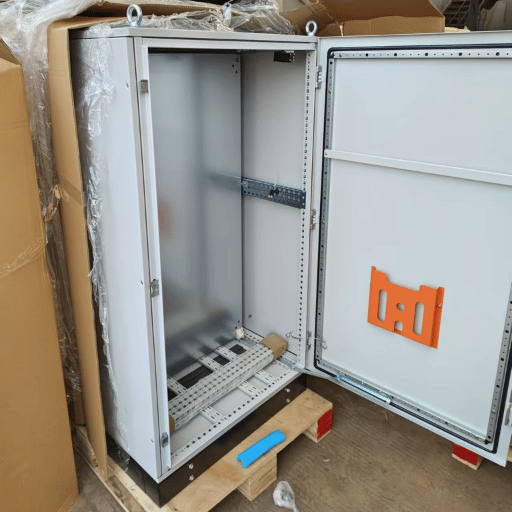
What IP rating does an outdoor edge computing cabinet need?
Many of the deployments you are replacing were built with a Ip55–this prevents damaging dust from entering any sensitive space and guards against particular water jet blasts from any angle. For work zones, coastal environments with more heavy duty particulate emissions, salt-spray. IP65 offers dust-tight filtering together with protection from water jets. Watch for corrosion: combine the IP rating with a NEMA 4X rating, which adds ASTM B117 salt-fog corrosion to the box.
How does thermal management work in sealed outdoor enclosures?
The sealed outdoor cabinets don’t use ventilation fans, as allowing their airflow pathways to open would breach the IP rating. They instead use air-to-air heat exchangers or compressor powered AC units. Heat exchangers transfer hot air from inside the unit to a thermally conductive barrier, where it heats incoming cold air.
The two airstreams don’t mix, so neither dust nor moisture enters the units. Compressor-based AC units work similarly to standard air conditioners, and can cool the cabinet’s interior beneath ambient temperature – heat exchangers are unable to do this. Whether to use a heat exchanger or a compressor AC unit depends on the heat load; a heat exchanger will suffice up to around 2,500 W, with a compressor becoming necessary above that.
A passive convection system is sufficient below approximately 200 W.
What is the difference between NEMA 3R and NEMA 4?
NEMA 3R Eng., il. NEMA 3R Ker.: ventilation openings are allowed and protection against falling rain, sleet, and the formation of ice from the outside is provided; in accordance with the above requirements, Natural ventilation in the given locations can be used. NEMA 4: Grouping all joints and sealing joints under gaskets, no opening for ventilation would be … and protection against windblown dust, water from hose streams, fall rain and the formation of ice from the outside.
Can standard indoor server racks be used outdoors?
None. Our indoor server Hdibohas are fabricated from uncoated carbon steel with zero IP- or NEMA-rated containment, zero corrosion resistance, no thermal considerations for the -40C to +55C temperature fluctuations of outdoor installations. Vubiderobing outdoor or unprotected indoor Hudohbahs results in equipment failures due to moisture within 3-6 months.
What is a micro data center?
A is a stand-alone, pre-fabricated enclosure with integrated compute, HVAC, networking and power systems in a single enclosure. A micro data center generally comprises between 1 and 10 racks, with total IT loads of 5 kW to 100 kW. Micro data center is deployed at cell sites, retail locations, factory floors and roadside locations for processing data from autonomous vehicles—it is not cost-effective to deploy fully scaled Mapitada Mohohad infrastructure in these environments.
KDST’s NEMA 3 IP55 outdoor cabinets serve as protective enclosures for micro data center deployments, providing the physical security and environmental sealing surrounding the IT equipment.
How much does an outdoor edge computing cabinet cost?
Base pricing for a standard IP55-rated outdoor cabinet without integrated cooling starts at $2,000–$5,000, varying by size (18U–42U) and material. Adding a compressor-based AC cooling unit adds $1,500–$4,000. Fully integrated micro data centers with power distribution, active cooling, battery backup, and remote monitoring range from $15,000 to $50,000+ depending on capacity and redundancy.
Custom enclosures with built-in power, cooling, and monitoring from our team—built to your site conditions and equipment needs.
About This Analysis
KDST designs and manufactures protective enclosures for telecom and edge computing infrastructure. Our direct involvement in IP/NEMA-rated outdoor cabinet production, integrated thermal management systems, and DC power distribution architectures informs the technical parameters and deployment guidance presented in this article. The rating comparisons and selection criteria reflect field data from projects our engineering team has delivered across the Asia-Pacific region and beyond.
References and Sources
- ASHRAE TC 9.9 — Thermal Guidelines for Data Processing Environments, 5th Edition — ASHRAE
- IEC 60529 — Degrees of Protection Provided by Enclosures (IP Code) — International Electrotechnical Commission
- NEMA 250 — Enclosures for Electrical Equipment (250-2020) — National Electrical Manufacturers Association
- ETSI EN 300 132-2 — Power Supply Interface at the Input to Telecommunications and Datacom Equipment, Part 2: 48V DC — ETSI
- Edge Computing Market Size, Share & Trends Analysis Report, 2024–2030 — Grand View Research
- ASTM B117 — Standard Practice for Operating Salt Spray (Fog) Apparatus — ASTM International