A UPS battery cabinet does one thing and one thing only: it organizes your power protection assets into a safe, accessible, environment room that you don’.t have to climb over. If you choose the wrong cabinet—wrong form factor, wrong NEMA rating, or wrong thermal design plan—the necessary battery string the cabinet is protecting degrades years early or possibly fails silently.
Each section below covers a distinct engineering decision: cabinet types, NEMA rating selection, kVA and runtime sizing formulas, battery chemistry trade-offs, outdoor installation requirements, and the maintenance intervals that extend battery life — all in a format directly applicable to procurement and installation decisions.
Quick Specs Reference
Capacity Range
1 kVA – 1,000+ kVA
DC String Voltage
12 V – 480 V DC
Battery Types
VRLA, Li-Ion, High-Rate VRLA
Operating Temp
0°C to 40°C (standard)
NEMA Rating Range
NEMA 1 (indoor) – NEMA 4X (outdoor/corrosive)
Standard Runtime
5 min – 60+ min (application-dependent)
What Is a UPS Battery Cabinet?
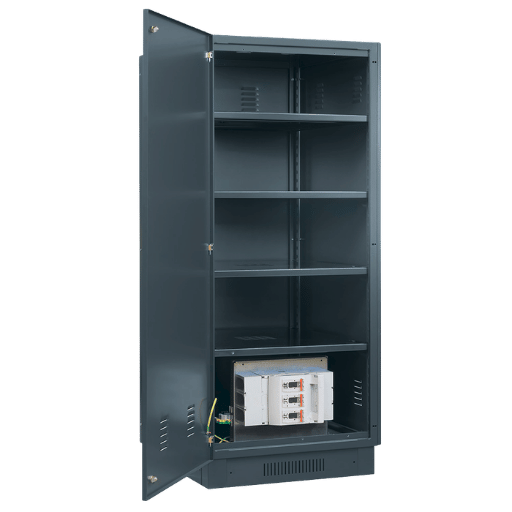
A UPS battery cabinet is the physical enclosure that contains the battery modules, DC bus and any monitoring equipment supplying backup power to the UPS during a mains power outage. The battery cabinet is not part of the UPS inverter/charger unit (although both can be contained within a single enclosure in smaller applications).
What does UPS stand for in electrical terms?
UPS stands for Uninterruptible Power Supply — any device that provides near-instantaneous backup power when the input supply fails or drops below acceptable voltage. Its energy storage component is the battery cabinet, sometimes called a battery enclosure or UPS battery enclosure when specified separately from the inverter unit.
In the largest installations the UPS and the battery string are physically separated for utilitarian purposes since the battery strings have somewhat different cooling requirements compared to power electronics, batteries need to be replaced from time to time without putting the inverter offline and the ultimate site configuration in some cases would have a battery room (or outdoor battery cabinets) located some distance from the UPS control panels.
Standard internal components in a UPS battery cabinet:
- Battery modules (VRLA or Li-ion cells in series/parallel strings)
- DC bus bars and inter-cell cabling
- Circuit protection (fuses or MCBs per string)
- Batterycharger.—is a central command controlling all function of a lithium-ion (Li-ion) battery pack, but is not required for a vrla[absorbed valve-regulated lead acid (VLRA)] battery.
- Ventilation or active cooling (the prior depending on NEMA classification and battery chemistry).
- Monitoring/communications interface (SNMP, Modbus TCP, or dry-contact relay)
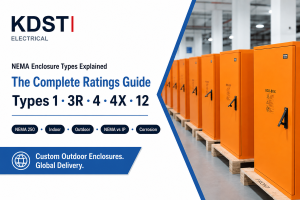
The NEMA 250 enclosure type classifications are used to specify the UPS battery cabinets for the environment – indoor, outdoor, industrial wet and corrosive. This is discussed in detail in the NEMA ratings section below.
Types of UPS Cabinets: Tower, Rack-Mount, Modular & Outdoor

Choosing the form factor is a purchasing dilemma that builds upon itself. Oversized rack-mount with non-expandable cabinets and tottery tower-u determined to require a full-too ware units for UPS use have a pattern of purchasing for the largest possible loads and longest run times.
| Type | Typical kVA | Footprint | Expansion | Common NEMA | Best For |
|---|---|---|---|---|---|
| Tower | 1–20 kVA | Small/medium floor | External EBC only | NEMA 1 | Small offices, PLC rooms |
| Rack-Mount | 1–40 kVA | 19-inch rack bays | Additional battery shelves | NEMA 1 / 12 | Data centers, server rooms |
| Modular | 10–1,000+ kVA | Scalable frame | Hot-swap modules, N+1/2N | NEMA 1 / 12 | Data centers, critical infrastructure |
| Outdoor Standalone | 5–500 kVA | Pad or pole-mount | Separate EBC, parallel units | NEMA 3R / 4 / 4X | Telecom sites, traffic systems, substations |
UPS Cabinet Selection Matrix
| Steady Load | Environment | Runtime Needed | Redundancy | → Cabinet Type |
|---|---|---|---|---|
| <10 kVA | Indoor, clean room | <15 min | N | Tower, NEMA 1 |
| 10–100 kVA | Indoor, industrial | 15–30 min | N+1 | Rack-mount/Modular, NEMA 12 |
| Any kVA | Outdoor, temperate | 15–60 min | N+1 | Outdoor standalone, NEMA 3R |
| Any kVA | Outdoor, corrosive/wet | 30–60 min | 2N | Heavy-duty outdoor, NEMA 4X |
If there is any installation over 40 kVA, the modular systems merit special attention. The availability to add hot—in operation—battery modules, without bus interruption, avoids the forced over-dimensioning of the fixed-capacity Tower & Rack architectures. For installations with battery capacity growth forecasted in five years or less, the modular acquisition premium is be recovered during the first battery change out.
NEMA Ratings for UPS Cabinets: Matching Protection Level to Environment

What is a UPS enclosure?
A UPS enclosure is the protective housing — rated to NEMA 250 or IP standards — that shields UPS battery modules, DC bus components, and monitoring hardware from environmental contaminants, moisture, and physical damage. Enclosure rating governs where the cabinet can be safely installed and what maintenance intervals apply.
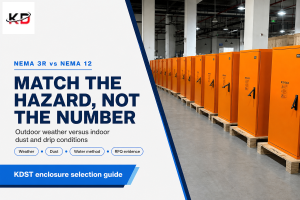
Incorrect NEMA type selection is the most prevalent UPS cabinet specification error. Overspecification (ordering NEMA 4X where a NEMA 3R would suffice) leads to increased cost and weight. Underspecification (placing a NEMA 1 cabinet in a location subject to splashing water or outdoor condensation) decreases the cabinet life and voids the warranty.
| NEMA Type | Protection Level | IP Equivalent | Typical UPS Application |
|---|---|---|---|
| NEMA 1 | General-purpose indoor; limits dust, light | IP20 | Office UPS, data center battery room (climate-controlled) |
| NEMA 3R | Outdoor; rain, sleet, external ice | IP24 | Outdoor telecom sites, traffic signals, substations — standard for 90%+ of outdoor UPS |
| NEMA 4 | Indoor/outdoor; windblown dust, rain, splashing, hosedown | IP65 | Food processing, industrial washdown areas |
| NEMA 4X | NEMA 4 + corrosion-resistant (stainless/fiberglass) | IP66 | Marine, chemical plants, coastal outdoor installations |
| NEMA 12 | Industrial indoor; dust, dripping/splashing liquids | IP54 | Factory floor UPS, industrial control rooms |
Teknisk anmerkning:NEMA 3R mot NEMA 4X for utendørsklima UPS.
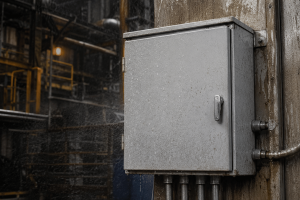
NEMA 3R provides protection from rain and sleet without a hosedown or condensation requirement — suitable for over 90% of outdoor telecom and data infrastructure UPS applications per NEMA 250 classifications. Specify NEMA 4X only where water jetting, chemical exposure, or coastal corrosion is explicitly documented in your site survey. The material and weight premium for NEMA 4X over NEMA 3R typically ranges from 25–40% for equivalent cabinet sizes.
Government specifications confirm this pattern. Texas DOT’s Special Specification 6007 (NEMA TS2-2003) requires outdoor battery backup units for traffic signal systems to carry NEMA-rated enclosures with at least 1,400-W continuous capacity — and identifies NEMA 3R, not NEMA 4X, as the standard outdoor protection level for roadside installations.
If you require a complete cross-reference between NEMA and IEC IP ratings for UPS enclosures then please refer to our NEMA vs IP rating comparison guide along with the relevant NEMA 3R enclosure specification reference.
How to Size a UPS Battery Cabinet: kVA, Runtime & Battery Ah Calculations

UPS cabinet sizes are arrived at by three steps in sequence: the first defines the as-deployled load in kW, then the load is converted at the power factor to kVA, and third, engineering margins are added in for harmonics, future size headroom and battery aging. If any step is omitted the result is an undersized (load trips under load) or oversized (capital waste) cabinet.
Core sizing formulas:
Add 10-20% Ah aging margin to VRLA batteries in their last 2 years of design life. A string reaching end of life provides 80% of rated capacity – if no aging margin was provided in the initial specification you will not meet your runtime requirement when you need it.
Three Worked Sizing Scenarios
| Application | Load (kW) | PF | Steady-state kVA | + 25% margin | → Frame Selection |
|---|---|---|---|---|---|
| PLC control room | 8 kW | 0.95 | 8.4 kVA | 10.5 kVA | 11 kVA frame |
| Production line with VFD | 30 kW | 0.85 | 35.3 kVA + 30% harmonic | 45.9 kVA | 60 kVA frame |
| Server + networking rack | 12 kW | 0.99 | 12.1 kVA | 15.2 kVA | 15–20 kVA frame |
📐 Engineering Note: Never Size on Nameplate kVA Alone
A 100 kVA UPS frame with 0.85 PF output serves only 85 kW of real load — and that figure drops further under harmonic-heavy IT loads common in mixed server/VFD environments. Apply your facility’s measured power factor, add harmonic derating, then apply the 1.25× headroom multiplier before issuing any RFQ. Nameplate sizing alone routinely produces 15–30% underspecification in industrial installations.
En guías de ingeniería del sistema de potencia de KDST, requieren también algunas tablas de referencia a otro tamaño para burles típicas cargas inmobiliarias.
Battery Chemistry Inside UPS Cabinets: VRLA vs Lithium-Ion
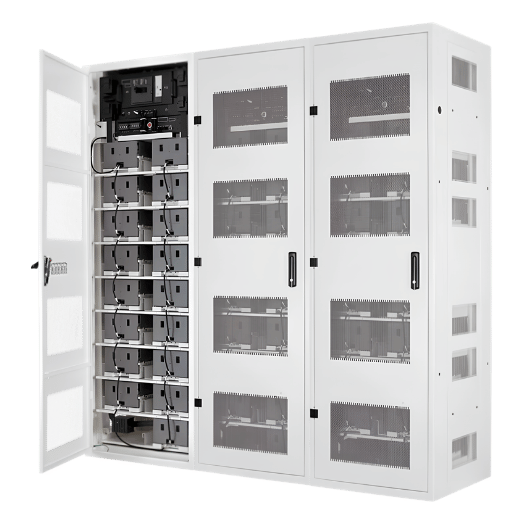
The selected chemistry determines the size of the cabinet, replacement frequency, cooling requirements, and the total ownership costs over a 10–15 year infrastructure lifetime. There are three key selection criteria: frequency of power events, ambient temperature range, and whether your maintenance team can operate the battery management system (BMS) communication stack that Li-ion requires.
VRLA (Valve-Regulated Lead-Acid)
Advantages
- Lower upfront cost per kWh
- Destocking anywhere the inventory of the service network is stocked which is very efficient.
- No BMS communication overhead
- Straightforward disposal and recycling compliance
- No fire code re-certification in most jurisdictions
Limitations
- Design life 3–5 years (temperature-dependent)
- greater weight per kWh—layouts from the point of view of racks structures
- Shorter cycle life at deep discharge depths
Lithium-Ion
Advantages
- Lithium-ion battery design life 8–12 years — typically outlasts two VRLA replacement cycles
- 40–60% weight reduction for equivalent kWh
- Smaller footprint — relevant for dense rack environments
- Better performance in frequent discharge cycle applications
Limitations
- Higher upfront cost (2–3× VRLA at equivalent capacity)
- BMS integration required — adds communication and commissioning complexity
- Must for a fire code review and cabinet ventilation modifications for thermal runaway risk
- OEM-specific spare parts — distribution network thinner than VRLA
Lithium-ion UPS batteries can reduce footprint and extend cycle life for frequent discharge events, but they introduce BMS communications, thermal runaway mitigation expectations, and shipping constraints that change spare parts stocking.
High Rate VRLA (for short duration, high current discharges) is a usefully intermediate “bust” option for 5 – 15 minute bridging power, under high loads, such as industrial process control applications (typical of fast-start generator sets). High rate cells trade off energy storage density with maximum rate of discharge and cannot be used for data center type long run-time applications.
When making procurement decisions of KDST power system cabinets, our engineering team can determine the battery chemistry, string voltage, and Ah capacity requirements for your site load profile and runtime requirement.
Outdoor & High-Temperature UPS Cabinet Installation
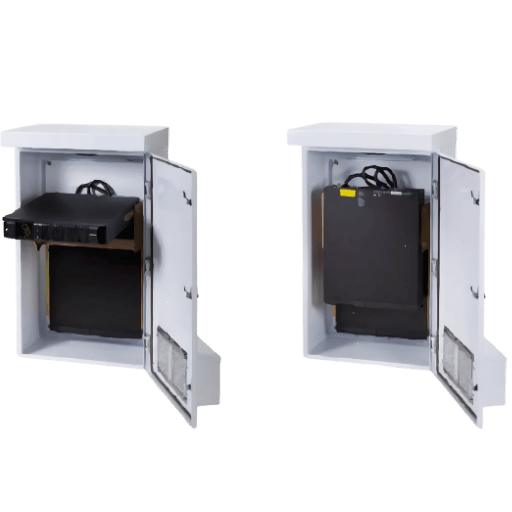
Temperature is not a second order concern with UPS cabinet installation-it is actually the first order requirement defining battery life and runtime dependability. Industry field data taken from both industrial and telecom installations identifies thermal issues as the root cause of more premature replacements than all other factors.
The 15°F Battery Life Rule
One of the main factors which significantly shortens the batteries’ lifespan in a UPS cabinet is an increase in the operating temperature. Increase 15F (8.3C) above 77F (25C) optimal operating temperature decreases VRLA battery life by a magnitude of something in the order of 50%}.
At 92°F (33°C) ambient, a 5-year VRLA battery has an effective life of ~2.5 years. At 107°F (42°C), roughly 15 months. This rule applies to VRLA; Li-ion follows a similar but less steep degradation curve.
Standard UPS cabinet operating range is 0C to 40C (32F to 104F) as shown in most manufacturer datasheets and the APC Matrix-UPS family documentation. Industrial units with extended ranges extend: Falcon Electric’s SSG-RP series is rated at 30C-65C, and Toshiba’s outdoor UPS line calls for 32F-122F, with humidity requirements, – but only in conjunction with active cooling systems, not passive ventilation alone.
Cooling options for outdoor and high-temperature UPS cabinet installations:
-
- NEMA 3R with integrated thermostatically controlled fans – appropriate for temperate climates with ambient below 35C; lowest cost option
- Active air conditioning (compressor or TEC) – needed when ambient routinely exceeds 35C; see our compressor vs TEC cabinet cooling comparison for choosing
- Remote battery cabinets in climate-controlled environments – run the UPS electronics in the hot space, isolate the battery string in a conditioned room; most cost-effective for high-ambient temperatures above 35C
- Thermal barriers and radiant shielding — for direct-sun-exposed pad-mounted installations, reflective cabinet coatings and overhead shade structures reduce solar load by up to 15°C
📐 Engineering Note: Remote Battery Cabinets for High-Ambient Sites
When ambient temperature regularly exceeds 35°C (95°F), remote battery cabinets in climate-controlled spaces are the recommended design approach. Keep the UPS power electronics in the process environment — they are less temperature-sensitive than electrochemical cells — and route the DC cable to a battery cabinet in an air-conditioned room. This configuration preserves battery life and simplifies replacement logistics without full environmental conditioning of the UPS enclosure.
Pre-installation assessment checklist for outdoor UPS cabinets:
- ✔ Temperature mapping (peak ambient, 30-day max, seasonal swing)
- ✔ Humidity and condensation risk assessment
- ✔ Dust and particulate analysis (industrial sites)
- ✔ Solar load calculation for south/west-facing pad installations
- Local electrical code compliance analysis (NEC 480 for battery systems)
- Seismic zone rating – read through this summary of seismic-rated cabinet criteria for Zone 3/4 specifications
- ✔ NEMA rating confirmation against documented site conditions
KDST’s outdoor telecom cabinets and outdoor communication cabinet range are engineered for high-ambient, outdoor UPS and power system operation – with NEMA 3R and NEMA 4X standards available to suit outdoor exposures.
UPS Battery Cabinet Maintenance: Testing Schedules & Replacement Triggers
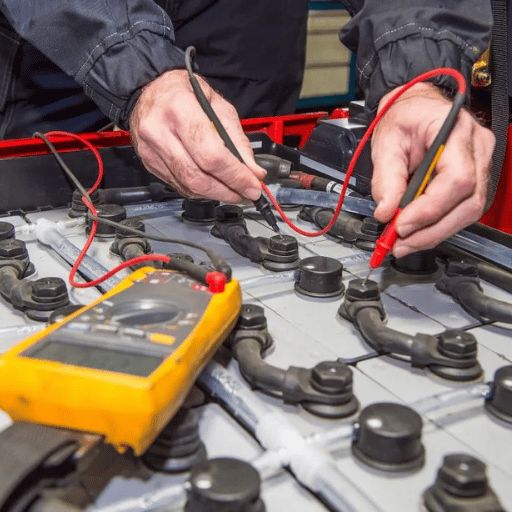
How long does a UPS battery last?
VRLA battery design life is 3–5 years under standard conditions (25°C ambient, regular float charging). Li-ion batteries reach 8–12 years in the same environment. Both figures depend on proper UPS maintenance — units that skip discharge testing for more than 2 years routinely fail below rated capacity when needed. The 15°F Battery Life Rule from the previous section compounds any neglected thermal management directly into shortened service life.
Maintenance schedules vary by environmental severity:
| Task | Standard Environment | High-Temp / Dusty / Outdoor |
|---|---|---|
| Visual inspection (connections, corrosion, swelling) | Quarterly | Monthly |
| Battery impedance/conductance test | Bi-annually | Quarterly |
| Full discharge test (to verify capacity) | Annually | Quarterly |
| Cabinet filter cleaning / vent inspection | Annually | Quarterly |
| Torque check on terminal connections | Annually | Bi-annually |
| SNMP/Modbus data review (temperature, runtime estimate, fault log) | Continuous (automated) | Continuous (automated) |
Battery replacement triggers (act on any one of these):
- Impedance trending 25%+ above baseline (from commissioning measurement)
- Discharge test confirms capacity below 80% of rated Ah
- Any cell voltage deviation beyond ±0.05V during float
- Visual evidence of swelling, leakage, or case deformation
- Nearing design life limits (VRLA: year 4; Li-ion: year 9 in standard conditions)
Modern UPS cabinet architectures feature SNMP v3 and Modbus TCP monitoring that can provide battery impedance trending, DC voltage per cell, battery runtime estimates, and cabinet temperatures to CMMS or building management frameworks – eradicating the silent failure modes endemic to manually-checked systems. The KDST engineering tools link details the SNMP and Modbus integration reference points.
UPS Cabinet Trends for 2025–2026: Modular Architecture, Li-Ion Adoption & Remote Monitoring

Three structural shifts are reshaping UPS battery cabinet specifications in 2025–2026. Each carries a direct procurement implication for engineers issuing RFQs today.
1. Modular construction becoming default in medium and heavy duty UPS. The modular UPS market set a record of $1.84B in 2025 with upward forecast through 2030. Scalable N+1 and 2N battery frames – where modules plug-in hot without bus disruption – replace fixed-capacity rack mounts in data center and mission-critical uses. When quoted, specify modular battery frames when project load budget exceeds 40 kVA, whether it’s needed or not.
2. Li-ion gaining momentum in data center UPS, VRLA holding in industrial. Global UPS battery market is projected at $4.33B in 2025. Within that, data center energy storage cabinet deployments are shifting toward Li-ion faster than industrial applications — driven by footprint constraints and frequency-of-use economics. Outside major metro areas, VRLA retains a decisive advantage through its distributor service network.
3. Remote monitoring moving from optional to required. SNMP v3 and Modbus TCP are transitioning from premium features to standard specification items in critical infrastructure UPS procurement. Operating evidence is clear: sites without remote monitoring of battery health have 3–5× longer mean time to detect silent battery degradation compared to monitored installations. Cybersecurity for UPS network interfaces — firmware update policy, OT network segmentation, and attack surface reduction — is accompanying this shift as a procurement specification requirement.
2025–2026 RFQ Recommendation
On any UPS machine RFQ issued in 2025 or 2026 make SNMP v3 and Modbus TCP communications mandatory specification items. Make the battery cabinet modular framed architecture mandatory for all installations above 40 k VA. Make seismic-rated cabinet specifications cross-referenced
– Zone 3 and 4 specification requirements are filtering into UPS cabinet procurement in California, Middle East, and Pacific Rim infrastructure projects.
Frequently Asked Questions: UPS Battery Cabinets
What is a UPS battery cabinet?
A rated enclosure that houses battery modules, DC bus, and monitoring hardware — delivering backup power when mains supply fails. May be integrated with the UPS inverter or housed separately in larger installations.
What is the difference between a UPS and a UPS battery cabinet?
Within a UPS system, the inverter unit contains the charger, static bypass switch, and control electronics. Battery cabinet cells supply DC current to the inverter during an outage. In small UPS systems, both are combined in one enclosure. Commercial and industrial installations above roughly 10 kVA typically separate the battery string into its own cabinet — simplifying replacement, capacity expansion, and thermal management without interrupting the inverter.
What NEMA rating is required for an outdoor UPS battery cabinet?
NEMA 3R degree of weather protection is considered the baseline for outdoor UPS appliance -it protects against rain, sleet, and the external ice forming on the enclosure but it requires no hosedown. NEMA 4X (corrosion-resistant, water jet hosedown rated) is specified when chemical attack, water-jetting, or coastal salt-air corrosion risk identified in site survey. US Army specification including TexasDOTs BBU Standard Specification specify NEMA 3R enclosure as the minimum for city government agency outdoor traffic infrastructure UPS.
How long should a UPS battery cabinet last?
VRLA batteries in a UPS cabinet have a rated design life of 3-5 years at 25C (77F) ambient temperature. Lithium ion batteries are rated 8-12 years under similar conditions. Both are heavily temperature dependent – applying the 15F Battery Life Rule, a VRLA battery in a cabinet running at 40C (104F) ambient has an effective service life of around 18-24 months rather than 3-5 years. All of the designs i include the elements of maintenance – quarterly discharge testing in hot environments and annual inspection/charge in cool.
How do I calculate the right size UPS battery cabinet?
Start with your measured load in kW. Divide by power factor to get kVA (kVA = kW ÷ PF). Add 20–35% for harmonic-heavy IT loads. Multiply the result by 1.25 for engineering headroom — this is your minimum UPS frame kVA. For battery Ah, determine your required runtime target and work backward from the formula: t ∝ (usable Ah × string voltage) ÷ (load kW ÷ inverter efficiency). Add 10–20% Ah aging buffer for VRLA systems. Worked sizing scenarios in the sizing section above illustrate this method across three common industrial applications.
Can a UPS battery cabinet be installed outdoors?
Yes — outdoor UPS battery cabinet installations are standard for telecom, traffic, and industrial infrastructure. Enclosure rating must be NEMA 3R or higher for outdoor exposure. Operating temperature should be maintained within 0C to 40C (standard envelope range) or an extended range cabinet with active cooling should be employed if ambient exceeds this. For sites with consistent ambient above 35 C, remote battery cabinet configurations in conditioned space extend battery life and performance relative to fully outdoor installations.
Engineering Inquiry
Specifying a UPS Battery Cabinet?
KDST engineering team can design power system cabinets for industrial, telecom, and outdoor UPS applications- including NEMA 3R and NEMA 4X enclosures with integrated temperature management systems. Please submit load specs and site conditions to receive a cabinet configuration recommendations.
Provide: kVA/kW load, runtime target, site ambient temperature, NEMA requirement, and any seismic or corrosion-zone considerations.
About This Analysis
This guide utilizes the NEMA 250 enclosure standard documentation (nema.org), Texas DOT Special Specification 6007 (NEMA TS2-2003), the CalcPanel Industrial UPS Sizing Guide, and Camali Corp’s high-temperature UPS installation engineering guide line. Engineering considerations are derived from standard electrical engineering practice and NEC 480 battery installation standards. Battery uptime figures are based on manufacturer spec’d design life. Site specific installations should be subject to engineering review.
References & Sources
- NEMA 250: Enclosures for Electrical Equipment (1000 Volts Maximum). National Electrical Manufacturers Association. nema.org/standards/view/nema-250-enclosure-types
- Texas Department of Transportation. Special Specification 6007: Battery Backup Unit (NEMA TS2-2003). 2024. ftp.dot.state.tx.us
- ASHRAE Technical Committee 09.09. Data Center Power and Cooling. ashrae.org
- CalcPanel. Complete Guide to Industrial UPS Sizing, 2026. calcpanel.com
- Camali Corp. Installing a UPS in High-Temperature Environments. camalicorp.com
- NEMA Enclosures Product Overview. National Electrical Manufacturers Association. nema.org/membership/products/view/enclosures
Related Articles
- NEMA 3R Enclosure Guide: Specification, Applications & Selection
- NEMA vs IP Rating: Cross-Reference Chart for Electrical Enclosures
- Compressor vs TEC Cabinet Cooling: Engineering Selection Guide
- Outdoor Communication Cabinets: Applications and Specifications Guide
- Cabinet U Space Explained: How to Count Rack Units for Power and IT Equipment