How to Choose a 42U Server Rack Cabinet for Your Data Center or Server Room
Quick Specs – 42U Server Rack Cabinet Overview
| Total Rack Units | 42U (73.5 in / 1,867 mm usable height) |
| Mounting Width | 19 in (482.6 mm) per EIA-310-D |
| External Width | 600 mm (23.6 in) or 700 mm (27.6 in) |
| Depth Options | 600 mm / 800 mm / 1,000 mm / 1,200 mm |
| Static Load Capacity | 2,000–3,000 lbs (varies by manufacturer) |
| Standard | EIA-310-D / CEA-310-E compliant |
A fully loaded 42U server rack cabinet has the capacity for over 3000 lbs of networking equipment, averages 5.7 kW per rail of power while fitting into a modest 78 inch tall package – and will still allow elevator access in most freight elevators. That combination of density, power capacity, and physical footprint is precisely why 42U has become the dominate form factor for data center and server room applications. Here we explain dimensions, construction, cooling considerations, and other important factors that affect the difference between an optimal purchase decision and costly shortfalls – with real technical data rather than marketing fluff.
What Does 42U Mean — and Why It Is the Data Center Standard
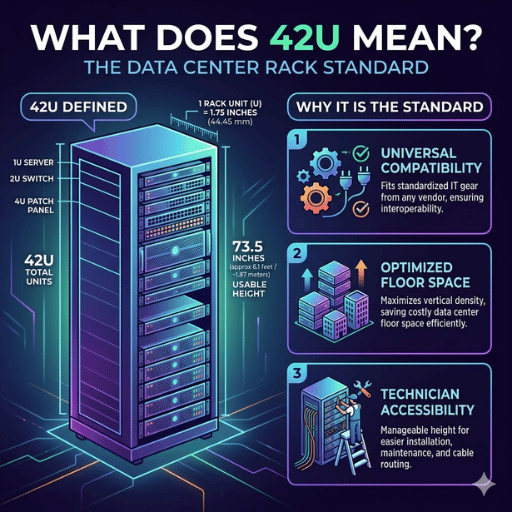
A rack unit (1U) is equal to 1.75 inches (44.45 mm) of vertical rack height. A 42U rack therefore can support 73.5 inches (1,867 mm) of internal mounting depth, reflected by the distance between the front rails of an enclosure. Actual total height of the cabinet is taller once you account for the outer shell of paneling along the top, sides, and base, with options for casters as well.
The modern 19-inch rack standard was established by AT&T to support its telephone relay racks in 1922. ANSI/EIA-310-D, published in 1992 and later revised as CEA-310-E in 2005, defines that the width between the mounting strips is 19 inches (482.6 mm), each mounting strip itself is 0.625 inches wide (15.88 mm), and the distance between the strips is 17.75 inches (450.85 mm).
📐 Engineering Note: The ANSI/EIA-310-D standard specifies that the hole pattern for mounting rails should have a cross section of 0.625 in (15.88 mm) square and be spaced horizontally at 17.75 in (450.85 mm). All rack unit products designed to this specification are mechanically interchangeable across compliant server racks.
What makes a 42U desired? From a weight capacity standpoint, a 42U enclosure on casters measures just under 2 meters tall (78 inches) and still enables access to all types of typical raised-floor ceiling plenums – 30-35% additional headroom before 28U-30U floor-standing custom server racks become a thorn in your side. Think about future business growth: this gives you extra space for switches, PDU’s, and patches without having to buy a new rack. Virtually all enterprise computers, down to 1U servers and 4U storage enclosures will ship assuming 42U rack mounts. That fact makes procurement and datacenter managers treat 42U as de facto for planning, purchasing, and deployment.
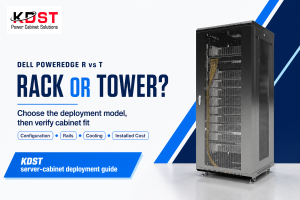
For this exact deployment profile, US manufacturer KDST Electrical offers enclosures compliant with the ANSI/EIA-310 standard, such as the IP40 server rack cabinet. These 42U short-depth cabinets feature fully adjustable mounting rails, locking front and rear doors, removable side panels, and a floor-anchored form factor specifically designed for server and data center environments.
42U Server Rack Cabinet Dimensions — Height, Width, and Depth Explained

Most difficult component to account for when designing a data center is rack enclosure dimensions. Inside depth measure is standardized at 73.5 inches (1,867 mm), but outside width and height are manufacturer specific and dependent of structural construction and optional casters.
Below is a sampling of the most popular 42U data rack cabinet configurations with adjustable depth:
| Specification | 800 mm Depth | 1,000 mm Depth | 1,200 mm Depth |
|---|---|---|---|
| Usable Mounting Height | 73.5 in (1,867 mm) | 73.5 in (1,867 mm) | 73.5 in (1,867 mm) |
| External Height (no casters) | 2,000 mm (78.7 in) | 2,000 mm (78.7 in) | 2,055 mm (80.9 in) |
| External Height (with casters) | 2,055 mm (80.9 in) | 2,055 mm (80.9 in) | 2,105 mm (82.9 in) |
| External Width | 600 mm (23.6 in) | 600 mm (23.6 in) | 600–700 mm |
| Mounting Width (19-inch) | 482.6 mm | 482.6 mm | 482.6 mm |
| Best Suited For | Network switches, patch panels, shallow 1U servers | Standard 2U–4U servers, mixed networking | Deep 4U storage arrays, GPU servers, high-density compute |
Pro Tip: Know your deepest piece of equipment, then add at least 150 mm to allow for rear cable pathway and PDU clearance. A Dell PowerEdge R750 (2U) deep equals 770 mm – this rules out 800 mm cabinets (if you need behind-the-mounting-rails vertical cable managers).
The most common mistake made when specifying a rack is choosing a 600 mm deep cabinet because of the lower entry price. At a total depth of 600 mm the available mounting depth with front and rear door clearances can be reduced to around 450 mm—this is far too shallow for any full size rackmount server built after 2015. Only reserve a 600 mm depth for wall-mount network rack or telecom patch-only applications—never for server racks with compute equipment.
Width is a much simpler formula: 600 mm external width allows for standard 19-inch equipment with side conduit clearance. If you intend to run vertical conduit managers on each side of the mounting rails within your enclosure step up to a 700 mm or wider cabinet—otherwise you will crush your conduit bundles against the side panels.
Enclosed Server Cabinet vs. Open-Frame Equipment Rack — When Each Makes Sense
This has nothing to do with one cabinet enclosure being better than another; these are simply two different environments for your server equipment.
✔ Enclosed Cabinet — Advantages
- Physical security: lockable front and rear doors
- Protection from dust and debris: IP40 rating prevents ingress of particles larger than 1 mm
- Directed airflow: perforated mesh door with measurable perforation percentage; optional 4 cooling fans in top panel
- Noise containment: reduces server fan sound pressure levels by 8-12dB at 1 m
- Cable concealment: cleaner appearance for shared office/server room spaces
⚠️ Open-Frame Rack — Advantages
- Cost: around 33% of equal size enclosed cabinets
- 360- degree access: no doors or access panels need to be removed during maintenance
- Passive ventilation: unrestricted airflow in climate-controlled rooms
- Weight: 45-80 lbs (no doors or panels) versus 275-350 lbs for enclosed cabinets
- Faster deployment: many ship fully assembled or require fewer components
| Factor | Enclosed 42U Cabinet | 42U Open Frame Rack |
|---|---|---|
| Approximate Cost (42U) | $800–$2,500 | $250–$700 |
| Ingress Protection | IP20–IP40 | None (IP00) |
| Noise Reduction at 1 m | 8–12 dB | 0 dB |
| Empty Weight | 275–350 lbs | 45–80 lbs |
| Physical Security | Lockable doors + panels | No enclosure |
Decision checklist — choose an enclosed locking cabinet when:
- The rack is in a shared space where unauthorized physical access may be desirable.
- The environment contains dust, debris, or other particles capable of entering through server intake fans.
- You need directed front-to-back airflow for hot/cold aisle containment
- Controlling noise is important—for example, if the racks are placed next to offices.
Choose a 42U open frame rack when:
- The rack is located in a dedicated protected access-only data center with filtered HVAC.
- Budget constraints dominate and the site is already gated.
- Frequent manual access from all four sides is required for rapid reconfiguration.
In environments requiring both protection and easy access, an IP40-rated server rack enclosure from KDST Electrical is suitable; offers lockable front and rear doors and usefully perforated front and rear panels; and balances physical security with the airflow properties needed to keep server inlet temperatures within ASHRAE recommended ranges.
Cooling, Airflow, and Temperature Control in 42U Cabinets

Keep in mind that heat is the greatest enemy of server reliability. Each watt dissipated by the equipment within a 42U rack each results in a similar amount of heat which needs to be removed; the cabinet itself impacts whether that heat efficiently exits to the ambient, or inevitably recirculates back into the servers.
Per the ASHRAE TC 9.9 Thermal Guidelines, keep your server inlets at a temperature between 18-27C, 64.4-80.6F; don’t thaw it out if it’s warmer than that right now. System component failure isn’t immediate at higher temperatures. But you will accelerate the demis of your electrolytic capacitor life spans in your power supplies and voltage regulators—as an example—every 10C the container gets hotter.
Regarding front door perforation:. Is it a reported ASHRAE recommended feature (note: David Coffer has raised an ASHRAE Complaint onfront door perforations)? A mesh front door with open area in excess of 64% will transfer a sufficient flow of cold air from the aisles to the server intake fans. Solid doors or decorative glass doors with an open area of under 40% create a pressure differential forcing the fans to operate harder and at a greater energy cost. (hot air exhaust manifolds will splay out toward the open door gaps).
📐 Engineering Note (ASHRAE): ASHRAE’s 2023 data center supplement recommends 3U spacing between high-power servers (above 500W per node) to reduce thermal hotspot formation by up to 60%. This applies primarily to GPU-accelerated and high-frequency trading deployments running at densities above 10 kW per rack.
Blanking panels of U’s covered with plastic or sheet metal filler plates are still often mistakenly considered as optional. An Uptime Institute survey indicated that 42% of data centers operate without blanking panels resulting in 15-20% reduction in cooling effectiveness. The hot exhaust air from the back of the rack re-circulates through the open gaps back to the front intakes creating a bypass airflow loop resulting in 5-8C higher inlet temperatures in severe instances.
💡 Hot/Cold Aisle Containment: For multiple rack deployments, configure the racks so that all server intakes face a single cold aisle and all extractor fans vent to a single hot aisle. Seal an overhead curtain or rigid panel at the tops of the aisles. This two way hot aisle – cold aisle configuration withholds the mixing of hot and cold air streams thus enabling the CRAC units to function with higher return temperatures reducing chiller plant requirements for cooling by a 20-30% margin.
For enclosed rack cabinets ensure that the rear doors have sufficient ventilation- a perforated door comparable to the open area of the front door at 64% open area will guarantee exhaust air exit without back pressure. Several network cabinet designs incorporate vented side panels as exhaust plenums for shallow server enclosure installations that do not require directional airflow for efficient cooling.
Cable Management and Power Distribution Inside a 42U Rack

Ensuring that a server rack is adequately and professionally cabling will show on operation at 2am on a weekend. When operation may be in an outage situation, adding in ring-cms cabling structures will definitely ensure this is always the case. Within a 42U server rack cabinet that is 20+ devices strong, structured cabling is non-negotiable.
Recommended cable routing sequence:
- Begin with Patch panels: Position 1U or 2U patch panels at the top of each logical grouping( network, storage, administration). Connect all network cables to a labeled port on a Patch panel- never connect directly to a switch.
- Horizontal cable managers: Center mount 1U horizontal cable management trays between every 6-8U of equipment. feed the cables horizontally through finger ducts before moving into the vertical leg channels.
- Vertical cable managers: Employ zero-U (flat mount) or side-mount vertical cable managers along each side of the rack.. Arrange data and power connections on opposite sides and install them in separate cable channels.
- PDU placement: Mount power distribution units (PDUs) vertically in the rear of the cabinet. Mount one on each side (power and backup redundancy) to minimize the length of power supply cords.
Provide brush cable entry points (sometimes called brush strip entries) at the top and bottom of the rack enclosure to run cables between cabinets. They prevent airflow leakage – about 80% as effective as sealed grommets, but permit tool-less adding and removing of cables. Many cabinets now ship with built-in cable management channels as standard.
Power Distribution Unit Types for 42U Server Racks
The PDU you choose will give you some level of control and awareness of power usage per outlet, circuit, and rack:
| PDU Type | Monitoring | Per-Outlet Control | Typical Price (42U vertical) |
|---|---|---|---|
| Basic | None | None | $80–$200 |
| Metered | Total amps/kW per circuit | None | $300–$600 |
| Switched | Total amps/kW per circuit | Remote on/off per outlet | $600–$1,200 |
| Monitored (Intelligent) | Per-outlet kW, voltage, power factor | Remote on/off + threshold alerts | $1,200–$2,500 |
Dual-rail PDU configurations running 30A at 208 V will supply roughly 5.7 kw to each cabinet. In typical mixed server/networking environments, such a configuration provides enough headroom to run at 60-70% capacity while maintaining a safety margin for peak draw events. The intelligent PDU market is expanding at a CAGR of 8.34% up to 2028 supported by demand for per-outlet power management in the colocation and enterprise data center industry.
Secure all cables into the rack with cage nuts and cable ties as appropriate. Do not use zip ties in a permanent installation—hook-and-loop straps allow faster changes and minimize jacket damage to the Cat6A, fiber during future maintenance.
Load Capacity, Construction, and Mobility Features

⚠️ Warning — Static vs. Rolling Load: A 42U rack rated for 2,500 lbs static load capacity does not have the same limit on casters. Rolling load may be 25-50% of the static rating- so a 2,500 lb static rack may only be able to handle 800-1,250 lbs while rolling. Always reference both specifications before rolling a loaded rack.
Refer to this load capacity reference guide for details.
A 42U server rack cabinet’s structural strength is determined by three factors: the steel gauge of its frame posts, the welding of the joints, and the construction of the base. Standard 19″ rack-mounted server cabinets use four vertical mounting posts and a base frame made from 16 gauge SPCC cold-rolled steel (1.5 mm thick). Side panels, top panels, and doors are constructed from 18 gauge steel (1.2 mm) — high enough gauge for sturdy construction but low enough to not add excess weight to non-structural surfaces.
Empty enclosed 42U rack cabinets: 275-350 lbs depending on construction, door style, and if it is shipped w removable side panels. Loaded total weight can be anywhere from 1,000 to 1800 lbs for a mixed server and networking installation. This is important for defining the warehouse floor loading metrics – A full loaded cabinet can put about 150-250 lbs per square foot of load on a raised floor tile depending on its footprint.
Key Construction Specs
- Frame posts — 16-gauge SPCC cold-rolled steel (1.5 mm)
- Panels and doors — 18-gauge steel (1.2 mm)
- Static load capacity — 2,000–3,000 lbs
- Empty cabinet weight — 275–350 lbs
- Floor-standing models equipped with Caster + leveling feet combination is already on most of these.
Unlike most 42U cabinets, they arrive with both casters and leveling feet. It is usually intended that the empty rack is rolled into position on casters, equipment loaded, then the leveling feet extended to raise the casters from the floor and secure the cabinet in its final placement. The ANSI MH16.1-2023 code of practice for industrial storage racks offers further guidance for anchoring and seismic bracing requirements for high hazard areas.
How to Choose the Right 42U Server Rack Cabinet for Your Setup

Having looked at dimensions, construction, cooling and cable management, then it’s simply a matter of deciding that the data cabinet specification is suitable for your deployment environment — whether a home lab, server room, or full-scale data center. Whether you are comparing 42U server cabinet options or full rack cabinet enclosures, these are the five most important considerations:
5-Point Selection Framework
- Measure your deepest server + 150 mm for rear cable management. If you have any equipment deeper than 700 mm, specify a 1,000 or 1,200 mm depth EIA-310-D rack.
- Loading capacity: total your planned equipment weight and add 20% for expansion. Make that number match or stay below the static load rating- not rolling load.
- Environment: shared office or warehouse=enclosed cabinet with lockable doors; dedicated data center with perimeter security=open frame is OK.
- Cooling method: specifies front and rear doors with perforated, 64% open area if hot/cold aisle containment is used; confirms passive ventilation is sufficient if data center cooling is used.
- Power density: total kW draw and dual-rail PDU specs. Most mixed deployment racks will need only a single pair of 5.7 kW/30A/208V rails. High density AI/GPU racks will probably require 3-phase PDU.
Decision Matrix: Home Lab vs. SMB Server Room vs. Data Center
| Factor | Home Lab | SMB Server Room | Data Center |
|---|---|---|---|
| Recommended Depth | 800–1,000 mm | 1,000 mm | 1,000–1,200 mm |
| Typical Equipment Count | 5–12 devices | 15–25 devices | 25–40 devices |
| Power Draw (typical) | 1–3 kW | 3–6 kW | 5–20+ kW |
| PDU Recommendation | Basic (120V/15A) | Metered (208V/30A) | Monitored dual-rail (208V/30A) |
| Cabinet Type | Open frame or enclosed | Enclosed with lockable doors | Enclosed, hot/cold aisle ready |
About This Analysis
KDST Electrical manufactures 42U server racks, data centers, enclosures- so we have a commercial stake in this! We wrote this guide as too many rack spec sheets leave buyers without the engineering context they need. Wherever we cite a standard document (EIA-310-D, ASHRAE TC 9.9), we link directly to the exact source so you can verify the information.
Frequently Asked Questions

What are the exact dimensions of a 42U server rack?
View Answer
A 42U server rack is only 73.5 inches (1,867 mm) of internal mounting height; the external height is about 2,000 mm (78.7 in) without casters and 2,055 mm (80.9 in) with casters. External width is usually 600 mm (23.6in.), depths can range from 800 to 1,200 mm depending on your hardware needs. The 19-inch or 482.6 mm mounting width is a standard for all EIA-310-compliant rack mount hardware.
What does 42U mean?
View Answer
42U allows for 42 rack units (RU) of rack-mounting space. One rack unit (U) is 1.75 inches (44.45 mm), so a 42U cabinet provides 73.5 inches (1,867 mm) of vertical rack space.
Can a 42U rack be used in a home lab?
View Answer
Yes, 42U racks are common for home labs (although it is more than most one-household home lab will require). A 42U rack is about 6.5 feet tall and weighs 275-350 lbs when empty. Make sure your floor can support the weight (can top 1,000 lbs.), there is enough air flow in the room to cool the equipment, and you can get it through the room door when the time comes.
What is the weight capacity of a 42U server rack?
View Answer
Most 42U servers racks support a static load capacity of 2,000 to 3,000 pounds. Rolling casters support is less- usually 25-50% of static load. Verify both ratings in the client’s datasheet before loading equipment.
How many servers fit in a 42U rack?
View Answer
On paper, 42U server racks can hold 42x 1U servers, but most data centers do not run that many servers in a single rack at once. Removing patch panel space (1-2U per), horizontal cable managers (1U per segment), network switches (1-2U each), and PDU mounting area leaves between 20 and 30 servers in each rack. ASHRAE specifies 3U of clearance space between high-density servers because of the challenge of thermal management.
What is the power consumption of a fully loaded 42U rack?
View Answer
Load will be driven totally by the servers and other hardware used. Typical mixed deploy of 1U & 2U servers and networking equipment can use 3-8 kW per rack. Very dense HPC & GPU accelerated racks can go >20 kW. A duplex rail PDU at 30A, 208V supplies approx 5.7 kW per pair of rails so most typical deployments only need a pair of PDUs. Very dense configurations may use power either 3 phase to 40-60A at a circuit.
References & Sources
- Wikipedia: 19-inch rack — EIA-310-D standard history, mounting dimensions, and AT&T 1922 origins.
- Wikipedia: Rack unit — Definition of rack unit measurement (1U = 1.75 in / 44.45 mm).
- Lawrence Berkeley National Lab / ASHRAE TC 9.9: Thermal Guidelines for Data Processing Environments — Recommended inlet temperature ranges and thermal management practices.
- ANSI MH16.1-2023: Industrial Steel Storage Racks — Structural and anchoring requirements for industrial rack systems.
- 42U.com: Data Center Temperature Guidelines — Blanking panel survey data and cooling efficiency benchmarks.
- Enconnex: Server Rack Weight — Static vs. Dynamic Load Capacity — Load rating methodology and safety margins.